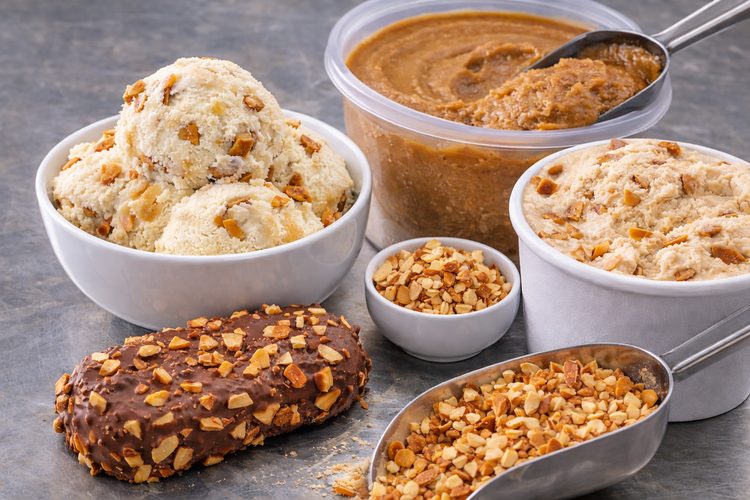
Frozen dessert applications force almond buyers to think differently about texture. A nut inclusion that seems pleasant at ambient temperature can become overly hard, too brittle or texturally aggressive once the finished product is held and consumed frozen. At the same time, almond pastes and butters that taste excellent on their own may behave very differently when dispersed into ice cream, gelato, soft-serve bases or frozen novelty fillings. That is why the best almond programs for frozen desserts are usually built around the actual eating temperature, process route and finished product architecture rather than a simple commodity-style ingredient quote.
In these categories, the almond may need to do one of several very different jobs. It may act as a visible inclusion that signals premium value. It may provide a roasted nut note in a ripple, swirl or variegate. It may be part of a nut base or paste that contributes body and flavor. It may need to maintain crunch in a frozen matrix without becoming tooth-challenging. Or it may need to be small and well-controlled enough to distribute evenly through a novelty coating, a pint-style inclusion system or a plant-based frozen dessert line. Because of that, buying the correct almond format is usually as much a texture-management exercise as it is a sourcing exercise.
Who this page is for
Ice cream and gelato manufacturers, frozen novelty producers, plant-based dessert brands, co-manufacturers, private-label teams and buyers evaluating California almond ingredients for frozen systems.
Main question
Which almond format delivers the right balance of flavor, crunch, visual identity and frozen-eating comfort without creating avoidable production or commercial problems?
Commercial theme
The lowest nominal almond price can still be the wrong choice if the inclusions are too hard at serving temperature, the paste does not integrate smoothly, or the pack format slows production.
Buyer takeaway: frozen dessert almond sourcing works best when the inquiry defines the actual application: inclusion, paste, butter, ripple, coating component, nut base or texture accent. “Almonds for frozen dessert” is usually too broad to generate truly comparable offers.
Contents of this guide
- How this topic shows up in real buying decisions
- Choosing between inclusions, pastes and butter-style formats
- Texture management at frozen temperature
- Cut selection, roast style and visual strategy
- Commercial planning, packaging and sourcing logic
- What Atlas would ask before quoting
How this topic shows up in real buying decisions
In practice, frozen dessert buyers rarely compare just one almond product. They often evaluate several possible routes at the same time: diced inclusions, chopped roasted almonds, sliced or slivered toppings, praline-style or coated pieces, almond paste, almond butter, smooth nut preparations and sometimes flour or meal for secondary texture systems. The correct choice depends on what the ingredient must do inside the finished product.
For example:
- A premium pint may need visible diced roasted almond pieces that remain pleasant to chew directly from the freezer.
- A gelato or frozen custard may use almond paste or butter to carry flavor more smoothly through the base.
- A novelty bar may need a controlled almond cut in the outer coating for visual coverage without excessive breakage.
- A swirl or variegate may require almond character in a paste or praline-style system rather than a hard particulate inclusion.
- A plant-based frozen dessert may use almond inputs both for flavor and for a creamier nut-forward identity.
Commercial reality: in frozen desserts, the same almond can be technically correct but commercially wrong if it delivers the wrong bite at frozen temperature. Texture failure is often what turns a promising sample into an expensive launch problem.
Choosing between inclusions, pastes and butter-style formats
The first question is usually not “which almond is cheapest?” It is “which almond format fits the product architecture?” Frozen dessert programs generally separate into three broad ingredient roles: particulate inclusions, smooth or semi-smooth nut systems, and hybrid texture components that sit somewhere in between.
| Format | Typical use in frozen desserts | Main advantages | Main watchouts |
|---|---|---|---|
| Diced or chopped almond inclusions | Mixed into ice cream, gelato, frozen yogurt, novelty centers or toppings. | Visible nut identity, crunch, premium cue, flexible inclusion rate. | If the size is wrong, the bite may become too hard or too sharp at frozen temperature. |
| Sliced or slivered almonds | Surface decoration, specialty inclusions, coating systems or visible mix-ins. | Elegant visual, good coverage, strong premium look. | Can be fragile, may fracture during handling and can feel more brittle if not well matched to the frozen application. |
| Praline-style or treated pieces | Higher-impact crunch systems, novelty coatings, ripples or premium inclusions. | Can deliver a more distinctive texture and sweeter flavor direction. | Specification needs to address texture target, handling stability and packaging suitability. |
| Almond paste | Flavor carrier in bases, swirls, fillings and layered desserts. | Smooth nut character, easier flavor distribution, less hard bite risk than particulate inclusions. | Requires clear expectations on texture, pumpability, oil separation tendency and color. |
| Almond butter or smooth nut preparation | Nut-forward frozen dessert bases, ribbon systems, premium flavor inclusions or plant-based concepts. | Rich flavor, creamy perception, strong nut identity and good formulation flexibility. | Must be matched to the process for viscosity, dispersion and package handling. |
| Meal or flour-type applications | Secondary textural or flavor systems in some formulated dessert components. | Can support a softer nut presence where visible inclusions are not desired. | Not a direct substitute for visible nut impact; functionality depends strongly on formulation design. |
Frozen dessert manufacturers often do best when they decide early whether the almond is mainly a bite component, a flavor component or a dual-function component. Once that is clear, the technical and commercial specification becomes much easier to write.
When to choose inclusions versus paste or butter
Choose inclusions when
- The consumer must clearly see the almonds
- The product needs crunch or bite contrast
- The brand wants a premium mix-in identity
- The nut is part of the visual hero story
- The frozen texture can be controlled through cut selection
Choose paste or butter when
- The product needs smooth nut flavor throughout
- Hard inclusion bite is undesirable
- A swirl, ribbon or creamy nut layer is the main effect
- The line is better suited to pumpable or spreadable formats
- The product concept prioritizes richness over particulate crunch
Texture management at frozen temperature
Texture management is central in frozen desserts because consumers eat the product cold. That changes how hardness, fracture, crunch and chew are perceived. A nut cut that works perfectly in granola or baked goods may not feel balanced in a frozen matrix. This is one of the most important points buyers should communicate to suppliers: the almond is not being evaluated at room temperature. It is being evaluated in a finished product at frozen or near-frozen serving conditions.
Inclusion performance is usually affected by several overlapping factors:
- Cut size and shape
- Roast level and brittleness
- Whether the piece is natural, roasted or otherwise treated
- The surrounding frozen matrix and its softness or richness
- Inclusion rate and distribution in the finished product
- Storage duration and pack conditions
Practical rule: almond inclusions for frozen dessert should be approved in the actual frozen application whenever possible. A bench sample can confirm flavor and appearance, but the final bite experience depends on the frozen matrix.
Texture problems frozen dessert buyers are really trying to avoid
Different frozen products tolerate these issues differently. A dense premium ice cream may hide certain textural edges better than a lighter frozen dessert. A novelty bar may need a more controlled almond particle because the bite experience is direct and concentrated. A swirl system may avoid hard-bite issues entirely by moving the almond into a semi-fluid or paste-based format.
How the almond job changes by frozen dessert type
| Frozen dessert type | Typical almond role | Main technical concern | Main commercial concern |
|---|---|---|---|
| Premium ice cream pints | Visible inclusions, ripple component or nut-forward flavor base. | Low-temperature bite and clean distribution. | Premium visual and repeatable spoon experience. |
| Gelato or frozen custard | Smooth paste, butter or smaller inclusions. | Flavor integration and refined texture. | Elegant sensory profile and consistent color. |
| Frozen yogurt or lighter frozen desserts | Texture contrast or nut flavor accent. | Balancing crunch without overwhelming a lighter base. | Good inclusion performance at value-sensitive formulations. |
| Novelty bars and coated sticks | Outer coating pieces, center inclusions or nut paste layers. | Adhesion, cut consistency and bite comfort. | Strong visual signal in a small format and efficient line handling. |
| Plant-based frozen desserts | Flavor base, butter, paste, inclusion or dual-function nut ingredient. | Texture contribution and compatibility with non-dairy systems. | Clear nut identity and concept differentiation. |
| Swirls, ribbons and variegates | Paste or preparation delivering almond flavor without hard particulates. | Spreadability, sensory balance and consistency. | Premium flavor delivery without complicating line performance. |
Cut selection, roast style and visual strategy
For frozen inclusions, cut size is often the most practical control point. The buyer is not only choosing how the almonds look; the buyer is choosing how the finished dessert will feel in the mouth. Smaller or more controlled cuts may reduce bite hardness and improve distribution, while larger pieces may create a stronger premium cue but can also increase the risk of an overly firm bite if not carefully matched to the product.
Large visible cuts
Best when the brand wants unmistakable premium identity and a generous inclusion look. More suitable when the frozen matrix and serving style can support a stronger bite.
Medium diced cuts
Often the most balanced industrial choice for pints and mixed inclusions, combining visibility, manageable bite and repeatable distribution.
Small controlled particulates
Useful in novelty coatings, delicate systems or applications where texture needs to stay comfortable and consistent across every bite.
Slices or slivers
Good for elegant appearance and coverage, but specification should account for fragility, handling damage and low-temperature brittleness.
Roast style also matters. A roasted almond can bring stronger flavor and a darker visual, but roast development may also change brittleness and how the piece fractures under frozen bite conditions. That does not make roasted almonds wrong for frozen desserts. In many premium concepts they are exactly right. It simply means the roast profile should be chosen in context of the desired bite, not only for standalone flavor.
Commercial rule of thumb: when a frozen dessert needs both premium visual and comfortable bite, buyers often benefit from a controlled medium cut rather than assuming bigger pieces will automatically create a better experience.
Texture, flavor and visual balance in paste and butter systems
When the almond role shifts from inclusion to flavor system, the specification needs to shift as well. Paste, butter or smooth nut preparations are typically judged less on particulate bite and more on flavor intensity, smoothness, color, oil behavior, process compatibility and how clearly they translate almond character into the finished frozen dessert.
Important commercial and technical questions often include:
- Does the paste need to be very smooth or slightly textured?
- Should the color be light and refined or deeper and more roasted-looking?
- How strong should the roast flavor be in the finished dessert?
- Will the product be pumped, folded, ribboned or pre-blended?
- Is the packaging suitable for the line, especially for pails, drums or other bulk handling formats?
- Does the nut preparation need to support a swirl, a layered filling or a full-base flavor system?
These questions matter because the wrong paste specification may not fail outright, but it can create slower processing, less attractive swirls, flavor dilution, non-uniform ribboning or avoidable internal handling cost.
Frozen dessert applications often require a more process-minded quote request
Frozen dessert manufacturing usually involves several texture-sensitive points: base preparation, inclusion feeding, variegate addition, fill conditions, hardening and storage. A strong quote request should therefore tell the supplier not only what product name is being requested, but also how it will be used operationally.
Inclusion into the base
If the almonds are going directly into the base or mix stream, buyers should define the desired cut, visual level, inclusion rate expectations and tolerance for bite firmness.
Swirl or ribbon use
If the almond format is part of a ripple or variegate, texture smoothness, spreadability and roast character often matter more than visible piece size.
Coating and surface systems
Novelty bars and coated formats usually need tighter control over cut size, visual coverage and how the almond behaves during handling and adhesion.
Plant-based concepts
In non-dairy systems, almond ingredients may carry both sensory and identity value, so consistency of flavor, texture and appearance can be commercially critical.
Packaging matters more than buyers sometimes expect
Almond ingredients for frozen desserts can appear straightforward, but packaging has real operational consequences. A good inclusion in the wrong pack can slow line feeding, increase handling damage or complicate warehouse rotation. A paste in the wrong container can create unnecessary labor, poor dispensing or product loss at the bottom of the pack.
Commercially relevant packaging considerations often include:
- Bag or carton format for diced and particulate inclusions
- Pails, drums or other bulk formats for paste and butter systems
- Pack size relative to batch size and line consumption rate
- Protection of visual integrity for premium inclusions
- Pallet stability and shipment suitability for domestic or export routes
- Lot coding visibility and document alignment for release and traceability
Operational note: frozen dessert teams often focus first on flavor and bite, but the fastest hidden costs frequently show up in pack handling, inclusion breakage, partial-use inventory and inconvenient bulk format choices.
Commercial planning and cost control
Frozen dessert almond buying should not be judged only on quoted price. The more useful commercial question is whether the ingredient delivers the intended sensory and operational result at the lowest realistic total cost. A cheaper inclusion that creates an overly hard bite, poor distribution or handling damage may become more expensive than a better-suited product with a slightly higher nominal price.
| Cost factor | Why it matters | Typical buyer question |
|---|---|---|
| Nominal ingredient price | Useful starting point, but not the whole picture. | Is the quoted item truly comparable in cut, roast, texture target and packaging? |
| Usable texture performance | A poor low-temperature bite can force reformulation or rejection. | Will consumers enjoy this almond format straight from frozen storage? |
| Visual efficiency | Some cuts create more visible premium impact per unit weight. | Can the brand hit its visual target without over-inclusion? |
| Line handling | Poor pack fit or fragile cuts can raise labor and loss. | Will this format run efficiently through our process? |
| Documentation and release speed | Missing or inconsistent paperwork slows launch and replenishment. | Will this product arrive with the right lot-level and shipment documentation? |
| Consistency over time | Frozen brands often depend on repeatable consumer experience. | Can the supplier support stable quality from trial to scaled commercial volume? |
Commercial planning should also reflect the real lifecycle of the project. Many frozen dessert programs begin with concept work, move into pilot batches, then scale quickly into launch volumes if the product tests well. That is why Atlas generally encourages buyers to describe whether the inquiry is for trial, validation, seasonal launch, year-round supply or export expansion.
Common formats buyers may compare in frozen dessert programs
What Atlas would ask before quoting
To move from a general concept to a specification-minded inquiry, Atlas would usually want the frozen dessert buyer to clarify the following points.
- What exact frozen product are you making? Ice cream, gelato, frozen yogurt, novelty bars, plant-based dessert, sandwich filling or another frozen concept.
- What is the almond supposed to do? Deliver visible crunch, carry flavor through a base, support a swirl, decorate a coating or create nut-forward creaminess.
- What bite experience is acceptable at frozen temperature? This often determines whether the right answer is a larger inclusion, a smaller cut or a smooth paste/butter route.
- Should the almond be natural, roasted or otherwise treated? Roast profile affects flavor, color and brittleness and therefore changes the low-temperature eating experience.
- How will the product be handled on line? Inclusion feeding, ribboning, pumping, filling and hardening all affect the right packaging and process fit.
- What is the commercial rhythm? Trial quantity, validation run, launch volume, repeat monthly supply or export-oriented program.
- What packaging and documentation are required? Industrial bulk, foodservice, private-label or export programs often have different handling and paperwork needs.
Typical frozen dessert use cases for almonds
- Premium almond inclusions in pints and tubs
- Roasted almond pieces in caramel, chocolate or coffee flavor systems
- Almond paste in gelato-style bases
- Smooth almond butter ribbons and nut swirls
- Controlled almond particulates in novelty coatings
- Plant-based frozen desserts with almond-forward sensory positioning
- Layered parfait or dessert cup components with almond texture accents
Commercial planning points
From a trading standpoint, frozen dessert almond programs work best when they are planned around repeatability. That means an agreed product format, a realistic low-temperature texture target, packaging that fits the production line, dependable lot documentation and a supply cadence that matches demand swings. This is especially important in seasonal or promotional frozen dessert businesses, where the window between approval and launch can be short.
When relevant, the brief should also clarify whether the program is:
- Industrial bulk for a manufacturing plant
- Foodservice-oriented
- Retail-ready or private-label
- Export-oriented with additional packaging and documentation needs
- Co-manufactured with extra approval stages
That single clarification often changes pack style, lead-time planning and the most suitable almond format.
Buyer planning note
Atlas Global Trading Co. uses application topics like this to help buyers move from broad interest to a more practical sourcing inquiry. If you are evaluating almonds for frozen desserts, the most useful next step is to share whether you need inclusions, paste, butter or another almond format, along with the frozen product type, target bite, roast direction, packaging format, estimated volume and destination. That helps convert a generic request into a commercial brief grounded in real California supply options.
Better brief, better bite: when the inquiry reflects the actual frozen eating experience and line process, almond quotations become far more useful and much easier to compare.
Need help sourcing around this almonds topic?
Use the contact form to turn this frozen dessert topic into a practical quote request for Atlas. Share the almond format, frozen application, texture target, roast direction, pack style and timing.
- State the exact almond format and dessert type
- Add the target bite and visual goal
- Include trial or monthly volume and timing
- Specify destination market and pack format
Frequently Asked Questions
What is the main buyer takeaway from “Almonds in Frozen Desserts: Inclusions, Pastes and Texture Management”?
The main buyer takeaway is that almond sourcing for frozen desserts works best when the product form, low-temperature texture target, inclusion size, roast profile, packaging and commercial timing are specified together.
Which almond formats are commonly used in frozen desserts?
Common formats include diced or chopped inclusions, sliced or slivered almonds, praline-style pieces, almond paste, almond butter, smooth nut bases and oil-containing nut preparations, depending on whether the product needs crunch, visual identity, nut flavor or creamy body.
Why is texture management different in frozen desserts?
Texture management is different because ingredients are eaten at low temperature. A nut that feels acceptable at room temperature may become too hard, too brittle or texturally unbalanced in ice cream, gelato, novelties or other frozen systems.
Should buyers choose inclusions or almond paste for frozen desserts?
It depends on the role of the almond. Inclusions are usually chosen for visible crunch and premium identity, while paste or butter-style systems are often better when the product needs smooth nut flavor, creamy richness or swirl-style delivery without a hard frozen bite.
Does Atlas help buyers move from article research to quotation?
Yes. Atlas uses the same application and specification topics covered in the academy to structure more practical quote requests around almond format, texture goal, roast profile, packaging, destination and volume.
Can this topic be applied to both U.S. and export programs?
Yes. The commercial logic is relevant to both domestic and export supply, although packaging protection, documentation, shelf-life handling and shipment planning may vary by market.