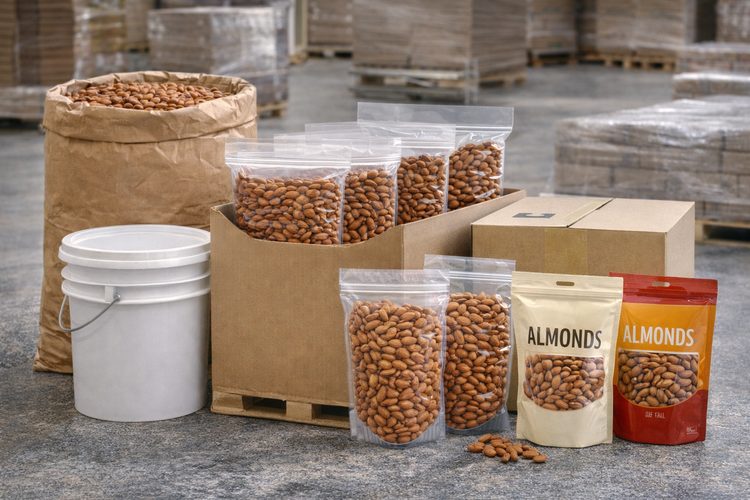
Packaging is one of the most practical and most underestimated decisions in almond sourcing. In real commercial programs, the buyer is not only purchasing almonds by weight. The buyer is also selecting how those almonds will be protected, handled, opened, portioned, palletized, shipped, labeled and replenished. The stronger commercial outcome usually comes from aligning product format, application, packaging route and shipment timing before the order is placed.
This matters because the same almond product can be commercially correct in one package and inefficient in another. A bulk industrial user may want larger packs that minimize handling labor and maximize plant efficiency. A foodservice operator may need a pack that preserves freshness after opening and fits a back-of-house portion routine. A retail-ready line may need strong barrier performance, attractive presentation and case packing that works in distribution. The almond itself may be unchanged, but the packaging decision changes the total delivered value of the program.
Why packaging should be treated as part of the specification
Many buyers begin by asking about almond grade, cut, roast or price, then leave packaging until later. In practice, that often creates delays because packaging is not a minor add-on. It affects product protection, labor efficiency, freight utilization, shelf presentation and repeat ordering logic. A packaging decision can also change which suppliers are a good fit, because not every program is built around the same route to market.
That is why Atlas generally treats packaging as part of the specification-minded inquiry. A useful quote should reflect not only the almond format but also whether the product will move as industrial bulk, foodservice-ready, retail-ready, private label or export retail. Those routes are commercially different even when the almonds are the same.
Commercial takeaway: the correct packaging program is not necessarily the cheapest per unit. It is the one that protects quality, fits the operating model and supports the real commercial route from warehouse to line to end customer.
How this topic shows up in real buying decisions
For almonds, the quote should reflect the real format and route. Whole or kernel material is different from diced cuts, meal, extra fine flour, butter or oil. The commercial logic also changes when the material is raw, pasteurized, dry roasted or oil roasted. Once packaging is added, the differences become even more pronounced because powders, inclusions, whole kernels and nut butters do not travel or handle in the same way.
For almonds buyers, the usable product menu usually includes raw almonds, pasteurized almonds, dry roasted almonds, oil roasted almonds and processed derivatives. Which of those makes sense depends on the end use, whether the customer is manufacturing further, serving in foodservice, packing for retail or planning export distribution. Packaging should therefore be selected around both the product and the user. The best pack for a bakery plant is not automatically the best pack for a hotel kitchen or a supermarket shelf.
The three main packaging routes
Most almond packaging discussions fall into three broad channels: bulk industrial packaging, foodservice packaging and retail packaging. These are not merely different sizes. They represent different handling assumptions, cost structures and quality expectations.
Bulk packaging is usually designed for further manufacturing. The emphasis is on efficient receiving, storage, batching and repeat throughput. Product protection matters, but so do pallet density, pack opening convenience for plant staff and minimizing unnecessary secondary packaging cost.
Foodservice packaging sits between industrial and retail logic. It usually needs to be practical for kitchens, catering or prepared-food operations. Portion size, ease of opening, reseal or short-term handling convenience and the amount of time the product stays open in a working environment can all matter.
Retail packaging adds shelf presentation, branding, consumer ease of use and final label execution. At that point the pack is no longer only a protective container. It is part of the selling proposition. This is especially important in premium snack packs, private label lines and export-ready retail programs.
Bulk packaging options for industrial almond users
Bulk packaging is commonly used for ingredient manufacturers, bakeries, confectionery plants, cereal producers, snack processors and plant-based dairy manufacturers. In these settings, the almonds are often opened quickly and moved into production, so the pack must support warehouse efficiency and line practicality. Typical industrial approaches may include multiwall bags, lined cartons, large corrugated cases or other bulk-oriented formats depending on the product and handling environment.
Whole kernels, sliced almonds, diced cuts, meal and flour each create different bulk-handling needs. Whole kernels may tolerate one style of pack and fill density, while powders or fine flour may require more attention to liner integrity, dust control and moisture protection. Almond butter or similar high-fat formats may move better in pails, lined containers or drum-style solutions where product recovery and sanitation expectations are different from those of dry goods.
Buyers evaluating bulk packaging should think about warehouse conditions, plant unloading routine, how many operators open the packs, how quickly the product is consumed once opened and whether the plant is sensitive to dust, breakage or partial-pack handling. Those details influence both cost and usability.
Foodservice packaging options
Foodservice packaging is relevant when almonds are used by restaurants, hotels, catering operations, bakery kitchens, meal-service providers and commissary environments. These buyers often need more manageable unit sizes than industrial plants but do not necessarily need full consumer-ready retail presentation. Their concerns are usually operational: portioning, storage after opening, back-of-house efficiency, freshness retention and consistency in service.
For whole roasted almonds or sliced topping formats, foodservice buyers may prefer packs that are large enough to support value but not so large that the product sits open too long in a working kitchen. For diced almonds, meal or flour, the pack may need to support repeated use over several service cycles. In practical terms, foodservice packaging often works best when the size matches realistic usage tempo instead of theoretical maximum economy.
This is one reason Atlas encourages buyers to describe the environment. A bakery chain, a hotel breakfast program and a premium dessert kitchen may all order almonds for foodservice, but they do not use them at the same rate or in the same way.
Operations note: the best foodservice pack is usually the one that balances labor, freshness after opening and usable yield in the kitchen. Oversized packs may reduce unit cost but can create avoidable handling or freshness issues in slower operations.
Retail packaging options
Retail packaging adds a completely different layer of complexity because the package must now sell the product as well as protect it. Stand-up pouches, flat pouches, small snack packs, multipacks, windowed packs, resealable structures and carton-packed units each create different impressions on shelf. They also influence fill weight communication, consumer convenience, freight efficiency and the economics of the program.
For retail almonds, the pack may need to support a premium, value, convenience, better-for-you or giftable position. That means the structure should be matched to the intended channel. A supermarket pouch, a travel-retail snack pack and a private label value bag are not interchangeable simply because they all contain almonds. Buyers should decide early whether the retail route is mainstream grocery, convenience, club, specialty, e-commerce, export distributor or another defined channel.
Retail packaging also tends to bring stricter artwork, label placement, barcode and case-pack planning considerations into the conversation. Even when a buyer begins with a product discussion, the program will eventually succeed or fail on whether the packaging route was chosen correctly for the retail objective.
How product form changes packaging logic
Almond packaging should always reflect the product form. Whole kernels, slivers and diced cuts are handled differently from meal and flour. Powders can require more attention to liners, seal integrity and dust containment. Nut butter and oil-based products create different sanitation, fill and pack-recovery needs. The same pack format that is efficient for roasted whole almonds may be inappropriate for almond flour or almond butter.
This is why Atlas generally asks buyers to define the exact product before discussing the best packaging solution. Packaging should follow the product’s behavior, not the other way around. Buyers who skip this step often receive prices that look similar on paper but are based on very different handling assumptions.
Barrier, freshness and product protection considerations
Packaging performance is especially important in almonds because product quality can be affected by exposure to moisture, oxygen, physical damage and repeated handling. The exact barrier requirement depends on format, processing status and how quickly the product will move through the chain. A short-cycle industrial ingredient program may need a different packaging emphasis than a long-shelf-life retail snack pack or export-oriented private label line.
Roasted products, retail packs and longer distribution routes usually make protective performance more commercially visible. In those cases, packaging is not just a shipping tool. It is part of the finished quality experience. For whole kernels, appearance protection matters. For sliced and slivered formats, breakage and particle control can matter. For finer products, seal integrity and liner performance become more important.
Palletization, case counts and shipping efficiency
Packaging decisions also affect how efficiently almonds move through the supply chain. Case count, pack dimensions, pallet pattern, stack height and the ratio of product weight to packaging weight all influence freight and warehouse performance. A commercially smart pack is one that fits the buyer’s logistics reality, not simply one that looks tidy on a specification sheet.
For domestic programs, buyers may be focused on warehouse fit and steady replenishment. For export programs, pallet stability, container utilization, labeling, secondary packaging strength and documentation alignment can become more important. These are not abstract logistics details. They can materially change landed cost and operational ease.
Shipping point: packaging decisions affect freight efficiency just as much as they affect product presentation. A good almond program should consider pallet and shipment logic at the same time as product format and pack size.
Retail-ready, private label and export-oriented packaging
When a program moves beyond industrial or standard foodservice into retail-ready or private label territory, packaging becomes even more specification-sensitive. The buyer may need consumer-facing graphics, precise fill-weight architecture, display-ready cases, reseal features or channel-specific secondary packaging. Export programs can add another layer: destination labeling, longer transit times, carton durability and pallet presentation requirements may all influence the correct packaging route.
This is why Atlas generally asks buyers to identify whether the program is industrial bulk, foodservice, retail-ready, private label or export-oriented. That one clarification often changes pack assumptions immediately. It also helps avoid quotes that look attractive but are built around the wrong route to market.
How packaging affects total delivered cost
Packaging affects cost in several ways. It influences material cost, fill labor, freight utilization, warehousing efficiency, product loss risk, retail presentation and how often the buyer must reorder. A slightly more efficient pack can reduce damage, improve pick-and-pack flow or simplify production. A poorly chosen pack can increase labor, create unnecessary waste and weaken the economics of an otherwise sound almond program.
That is why Atlas typically encourages buyers not to reduce the packaging discussion to unit cost alone. A bulk pack that is marginally cheaper may still be commercially weaker if it is difficult to handle or poorly aligned with usage tempo. A retail pack with stronger presentation may justify itself if the product is shelf-driven and premium positioned. The real decision should be made on fit-for-purpose value.
What Atlas would ask before quoting
Atlas encourages buyers to define intended use, pack style, destination, timeline and quality expectations early. For packaging-specific discussions, the most useful quote request usually includes:
- Exact almond product format: whole, raw, pasteurized, dry roasted, oil roasted, sliced, diced, meal, flour, butter or another form
- Channel route: industrial bulk, foodservice, retail-ready, private label or export-oriented
- Target pack type and fill-weight range
- Whether the pack should prioritize plant efficiency, kitchen handling, shelf presentation or a combination of those goals
- Carton and case-pack expectations, where relevant
- Destination market and shipping route
- Estimated launch, monthly or container-level volume
- Target timeline and whether the requirement is for trial, validation or repeat supply
Commercial planning points
From a trading standpoint, the best programs are built around repeatability. That means clear documentation, agreed packaging, sensible shipment cadence and a commercial structure that supports continuity rather than one-off emergency buying. This is especially true when packaging is customized for foodservice packs, retail-ready formats or private label programs. The more clearly the buyer defines the ongoing route, the more practical the packaging discussion becomes.
When relevant, the brief should also mention whether the program is industrial bulk, foodservice, retail-ready, private label or export-oriented. That single clarification often changes packaging, documentation and timing assumptions. In many cases, it also changes the most relevant cost metric from simple product price to total delivered program value.
Typical mistakes buyers can avoid
One common mistake is deciding the almond format first and assuming packaging can be solved later with minimal impact. Another is choosing a pack by nominal size without checking how it will actually be used on line, in kitchen service or on shelf. A third is comparing supplier offers where the pack structures, case counts and handling assumptions are not actually aligned.
It is also common to overlook the difference between a launch pack and a repeat pack. A first-run retail program may tolerate temporary workarounds that are inefficient in steady state. A good quote request should separate those stages so the packaging discussion reflects the real commercial plan.
Buyer planning note
Atlas Global Trading Co. uses topics like this to move conversations from broad interest to a specification-minded inquiry. If you are evaluating almonds supply, share the product format, packaging route, estimated volume and destination using the floating contact form so the next step can be grounded in a real commercial need.
Need help choosing the right packaging route for an almond program?
Use the contact form to turn this topic into a practical quote request with format, pack type, shipping route and commercial timing defined from the start.
- State the exact almonds format
- Add whether the program is bulk, foodservice or retail-ready
- Include target volume, destination and timing
Frequently Asked Questions
What is the main buyer takeaway from “Bulk, Foodservice and Retail Packaging Options for Almond Programs”?
The main buyer takeaway is that packaging should be chosen together with almond format, application, logistics route and volume rhythm. The right pack is the one that protects product quality and fits the actual operating model, not simply the smallest unit cost.
How do buyers decide between bulk, foodservice and retail packaging?
The choice usually depends on who is opening the pack, how quickly the almonds are consumed, whether the product is processed further, what shelf presentation is needed and how the goods will move through storage and shipping. Industrial users often prefer larger packs, while foodservice and retail programs need more portion-controlled and presentation-ready structures.
What should buyers specify before requesting a packaging quote?
Buyers should specify the almond format, intended application, pack type, target fill weight, carton configuration, destination market, pallet and shipping needs, and expected monthly or launch volume. Those points improve quote accuracy and reduce packaging revisions.
Can the same almond product use different packaging programs for different channels?
Yes. The same almond format may be sold in industrial bulk bags, foodservice packs or retail pouches depending on the channel. Product identity may stay similar, but case count, barrier expectations, artwork, labeling and logistics requirements usually change with the route to market.