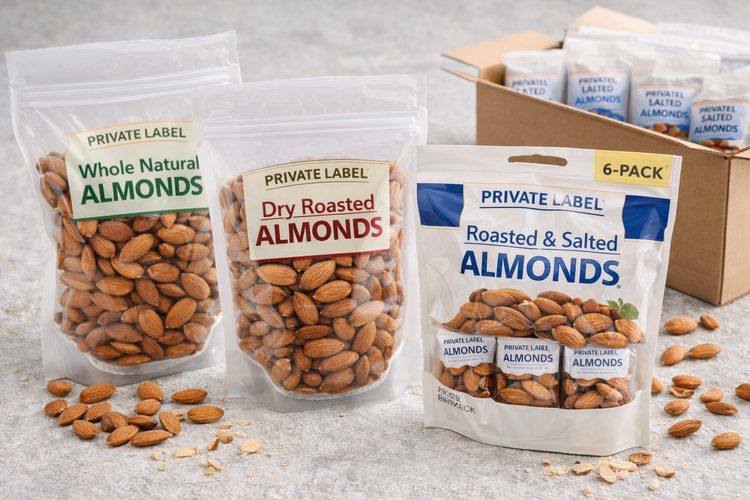
Private label almond programs are rarely won or lost on almond cost alone. The stronger commercial outcome usually comes from aligning product format, retail positioning, package structure, documentation, launch timing and replenishment assumptions before the order is placed. That is especially true when the product is expected to sit on a retail shelf under another party's brand, where execution quality is judged by appearance, pack functionality, fill consistency, label readiness and on-time delivery as much as by the almonds themselves.
In simple terms, private label is not just a supply question. It is a program-management question. The buyer is typically coordinating product form, artwork timing, target claims, carton logic, retail channel requirements, first production quantities, distributor expectations and repeat forecasting at the same time. A quote for private label roasted almonds in stand-up pouches is not directly comparable to a quote for natural snack packs, multipack cartons or export retail packs. Each route changes the commercial structure and the practical sourcing conversation.
Why private label almond programs need a different buying approach
Private label buyers are usually balancing more constraints than standard bulk ingredient buyers. They are not only asking what almond product is needed, but also how that product will be presented, who the end customer is, which channel it will enter and how the commercial risk is staged from first run to repeat replenishment. In many cases the buyer is working backward from shelf price, pack count, retailer expectations or a specific competitive benchmark.
That means the best private label program usually begins with a clearer brief than a standard spot inquiry. The buying team should already be thinking about format, roast profile, flavor style, pack weight, retail channel, carton count, destination, target launch window and the difference between development volume and repeat program volume. When those variables are defined early, supplier discussions become more comparable and far less reactive.
Commercial takeaway: private label almond programs work best when the brief covers both the almonds and the retail route. Product format, packaging architecture, target market and timing should be aligned before pricing discussions are treated as final.
How this topic shows up in real buying decisions
In practice, buyers often start with a broad product idea such as “private label almonds for supermarket,” “travel retail snack packs,” “export roasted almonds,” or “value-tier retail pouches.” That is still too broad for a reliable quote. The program could involve whole natural almonds, pasteurized kernels, dry roasted almonds, oil roasted almonds or flavored roasted almonds. It could also move through several retail-ready structures, including single pouches, resealable bags, carton-packed multiples, on-the-go snack packs or mixed retail assortments.
The commercial logic changes quickly depending on which route is selected. A natural whole almond pouch for a wellness-led grocery private label line is a different program from a bold-seasoned roasted almond range aimed at convenience retail. A club-format value bag behaves differently again, particularly on fill economics, shelf presentation and freight efficiency. In private label, the product choice and the packaging choice are usually inseparable.
Format selection: the first commercial decision
The first serious decision in a private label almond program is usually the finished product format. Buyers should decide whether the program is centered on whole natural almonds, roasted whole kernels, flavored roasted almonds, snack packs, multipacks, premium stand-up pouches, value bags or another defined format. Format selection matters because it sets expectations for raw material appearance, roast style, breakage tolerance, fill control, artwork space, price point and route to market.
Whole natural almonds often fit more straightforward, wellness-led or minimally positioned private label programs. They can support a cleaner visual concept but still require attention to size consistency and in-pack appearance.
Dry roasted almonds are frequently used when the program needs stronger crunch, a more developed flavor and a retail-ready snacking profile. Oil roasted almonds may be chosen when the product needs richer eating quality, surface seasoning support or a different flavor profile, though this changes both the ingredient deck and packaging conversation.
Flavored roasted almonds move the program into an even more specification-driven category because flavor coverage, residue, pack cleanliness, visual consistency and claim direction become more important. For these products, the brand position and retail channel should be defined early, because mainstream, premium and export-oriented flavor programs are not usually built the same way.
Private label channels and what they change
A supermarket own-brand line, a convenience-store private label, a drug-channel wellness snack, a club-value pack and an export distributor program can all use California almonds, but the commercial assumptions are different. Channel affects portion size, shelf format, pricing structure, graphics hierarchy, shipping cadence and acceptable product cost.
For example, a supermarket line may prioritize strong shelf presence, familiar pack sizes and repeat replenishment. A convenience program may lean toward smaller snack packs with more flavor-forward formats and rapid velocity expectations. A club or warehouse model may place more emphasis on larger packs, efficient cartonization and sharper cost control. Export channels often add packaging durability, labeling and documentation complexity on top of those decisions.
Pack architecture and retail presentation
Pack architecture is one of the most important parts of a private label almond program because it influences both consumer perception and operating cost. A stand-up pouch, pillow pouch, sachet, multipack carton or value bag each creates a different retail experience. The pack also controls how much billboard space is available for the private label brand, nutrition panel, claims, use cues and origin or quality messaging.
Private label buyers should therefore decide whether they need a simple pouch, a resealable structure, a shelf-ready carton with multiple inner packs, or a format optimized for travel, checkout, club retail or e-commerce. These decisions affect more than appearance. They influence case count, pallet utilization, finished product damage risk and the efficiency of both domestic and export logistics.
In many programs, the pack should be chosen with the almonds in mind. A premium whole-kernel product may benefit from a structure that protects appearance and fill impression. A single-serve snack pack line may need packaging optimized for line speed and uniform fill. A flavored roasted program may require better pack control around residue, seal integrity and in-pack cleanliness.
Pack planning point: private label economics are often shaped as much by pack choice as by nut cost. The correct packaging format can improve shelf presence and repeatability, while the wrong one can create avoidable waste, inconsistent value perception and slower line performance.
Claims, positioning and specification discipline
Private label buyers often begin with merchandising language such as natural, roasted, premium, everyday value, on-the-go, simple ingredients, family size or export retail. Those positioning ideas matter, but they need to be translated into technical-commercial language before quotation. A supplier cannot quote “premium” without knowing what that means in product form, appearance standard, roast style, pack size and market destination.
That translation step is especially important when the program includes front-of-pack claims, retailer-specific rules or a branded look that depends on a certain fill appearance. A natural and lightly positioned line may require a different product surface, visual grade and pack cleanliness than a flavored convenience item. A premium export line may need different carton presentation and outer-pack execution than a domestic supermarket line, even if both start with roasted almonds.
What private label buyers usually need to specify
A stronger quote request for private label almonds usually includes the product form, roast style, intended retail channel, target pack size, packaging structure, carton configuration, expected shelf position, destination market, launch window and estimated commercial stages. Even a preliminary brief built around those items can dramatically reduce avoidable re-quoting and confusion between suppliers.
Buyers also benefit from stating whether the first requirement is for concept review, trial production, retail pitch samples, initial launch volume or established replenishment. Those stages are commercially different. A sample-stage requirement and a repeat replenishment program should not be treated as though they have the same risk profile or packaging assumptions.
Documentation, artwork timing and launch readiness
One of the practical realities of private label work is that launch timing depends on more than product sourcing. Artwork approval, pack print timelines, carton configuration, retailer onboarding, coding requirements and regulatory review can all affect when the program is truly ready to ship. That means almond supply planning should be coordinated with packaging readiness instead of being treated as a separate later step.
From a commercial standpoint, this is where many private label programs either gain clarity or lose time. If the buyer has not aligned product specification with packaging lead times and launch sequence, even a technically correct almond supply quote may not fit the actual go-live plan. Atlas generally encourages buyers to bring timing into the first discussion rather than after the product format is already assumed to be fixed.
Launch staging: from concept to repeat program
Most successful private label almond programs move through several practical stages. The first stage is usually concept definition, where the buyer narrows the intended format, channel and visual direction. The second stage is trial or sample review, often used to compare flavor profile, pack appearance and internal alignment with the retail objective. The third stage is launch planning, where commercial pack sizes, carton counts, artwork timing and first production quantities become more concrete. The final stage is repeat replenishment, where consistency, forecast rhythm and operational continuity matter most.
This staged approach matters because it affects how suppliers should think about pack sizes, documentation, minimums and timing. A buyer asking for “best price” before clarifying the stage of the project may get an answer, but it may not be the right answer for the program's real operating needs.
Forecasting, continuity and replenishment discipline
Private label programs usually work best when the buyer and supplier are planning for continuity, not one-off emergency purchases. Once a retailer listing or distributor launch is secured, the emphasis often shifts from initial enthusiasm to repeatability. That means the program needs realistic forecast rhythm, agreed specifications, clear shipment windows and practical lead-time assumptions.
In other words, private label is often won in launch planning but protected in replenishment discipline. If the specification, pack model and forecast logic are weak, the first shipment may still happen, but the program becomes harder to sustain smoothly. Buyers who define likely monthly rhythm, seasonal peaks, promotional periods and container or pallet logic early tend to get more useful supply discussions.
Domestic versus export private label programs
The same core product logic can apply to both domestic and export private label programs, but the commercial path changes. Domestic programs may prioritize shorter lead times, faster packaging turns and more flexible replenishment. Export programs often require more deliberate planning around packaging durability, labeling language, palletization, documentation, shipment timing and destination-specific presentation.
For export-oriented private label, it is especially useful to define whether the product is being sold into mainstream retail, specialty retail, gifting, travel retail or distributor-led market testing. That context affects pack architecture, product selection and logistics assumptions. A format that works well for domestic supermarket distribution may not be the right answer for long-transit export retail.
Export note: in export private label programs, packaging and documentation can become as important as the almond format itself. The earlier those variables are defined, the more realistic the supply discussion becomes.
Common buying mistakes private label teams can avoid
One common mistake is trying to finalize pricing before the pack architecture and channel are defined. Another is selecting an almond format based on a generic product sample without checking whether the same format supports the intended shelf price, visual impression and supply rhythm. A third is underestimating the time needed to align product, packaging and artwork readiness.
It is also common for teams to compare supplier offers that are not actually comparable. One quote may assume natural whole almonds in a simple retail pouch. Another may assume roasted product, different case counts or a different pack structure entirely. Without a clearer brief, the price comparison can be misleading.
What Atlas would ask before quoting
Atlas generally recommends translating the idea into a quote request with the commercial details that materially affect private label success. For example:
- What is the exact almond product format: natural, dry roasted, oil roasted, flavored roasted, snack pack or another retail-ready format?
- Which retail channel is the line targeting: supermarket, convenience, club, travel, export retail or private distributor?
- What pack style is planned: stand-up pouch, pillow pouch, multipack carton, value bag or other defined format?
- What is the target pack size and carton configuration?
- Is the line positioned as premium, mainstream, value, on-the-go or export giftable?
- What is the destination market and expected launch timing?
- Is the immediate need for samples, validation, launch volume or repeat replenishment?
- What monthly, seasonal or container-based volume assumptions should be considered?
Commercial planning summary
Private label almond programs are built by linking product choice to launch reality. The correct almond format depends on the finished retail concept, not just on a raw ingredient name. Whole kernels, roasted formats, snack packs and value pouches each have different implications for shelf appearance, packaging, fill economics, logistics and replenishment. The commercial structure becomes stronger when those choices are made deliberately instead of being solved reactively after packaging or retailer timelines are already fixed.
Atlas Global Trading Co. uses topics like this to move conversations from broad interest to a specification-minded inquiry. If you are evaluating a private label almond program, the most useful next step is to share the product format, target channel, pack architecture, estimated launch stage, expected volume and destination. That helps convert a general idea into a more practical California sourcing discussion.
Need help moving a private label almond line from concept to launch?
Use the contact form to turn your retail idea into a practical quote request covering format, channel, packaging logic and commercial timing.
- State the almond format, roast style and retail channel
- Add target pack size, carton structure and launch stage
- Include destination market, timing and expected volume rhythm
Frequently Asked Questions
What is the main buyer takeaway from “Private Label Almond Programs: From Format Selection to Launch”?
The main takeaway is that private label almond programs work best when product format, target retail channel, pack architecture, artwork timing, forecast assumptions and commercial staging are defined together before launch.
What should a buyer define before requesting a quote for a private label almond program?
A strong brief should define the almond format, roast style, flavor profile, target pack size, packaging structure, carton configuration, destination market, claim direction, expected launch timing and trial or annual volume.
Why does format selection matter so much in private label almonds?
Format selection affects shelf appearance, consumer use case, fill economics, pack design, line efficiency and repeat buying performance. Whole kernels, roasted products, snack packs, retail pouches and other formats are not commercially interchangeable.
Can this topic be applied to both U.S. and export programs?
Yes. The same specification logic applies to domestic and export private label programs, although packaging, documentation, labeling and shipment planning may vary by destination.