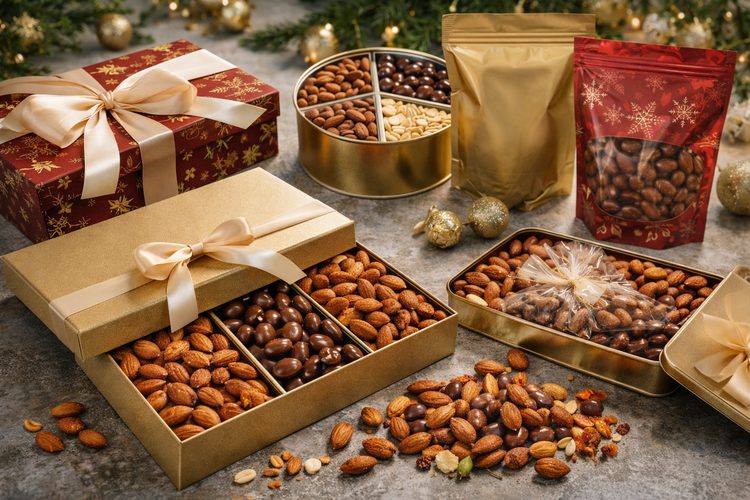
Seasonal gifting is not just a packaging exercise. In almonds, it is usually a combined decision about kernel selection, visual grade, roast character, flavor system, pack protection, merchandising format, labeling language, sell-through window and freight timing. A premium gift box can look simple from the outside, but behind that finished presentation is a specification chain that often runs deeper than a standard commodity nut program.
For Atlas, this topic matters because buyers often begin with a broad request such as “premium almond gift packs” or “holiday almonds assortment,” while the real commercial decision depends on what the finished pack is trying to do. Is the pack designed for corporate gifting, supermarket seasonal display, travel retail, specialty food stores, department store hampers, online gifting, hotel welcome kits, private label festive promotions or export retail? Each route changes the right almond format, the outer pack style, the fill-weight logic and the cost structure.
In practical buyer terms, seasonal gifting and premium pack development for almond products should be treated as a product architecture project, not only a sourcing project. The almond itself may be whole natural, dry roasted, seasoned, chocolate coated, honey roasted, smoke flavored, sliced for blends or used as one component in a multi-item assortment. But the commercial success of the program often depends on whether the buyer defined the sensory target, price point, packaging hierarchy, transport risk and replenishment calendar early enough.
Why premium gifting changes the buying logic
Standard industrial almond procurement often prioritizes functional use: consistent cut size, throughput on line, flavor neutrality, blendability, roast tolerance or ingredient cost per kilogram. Premium gifting programs shift part of that logic toward presentation performance. The buyer is no longer asking only whether the almonds process well; they are also asking whether they look premium through a window panel, hold crispness in a decorative carton, survive last-mile handling, support an elevated flavor story and create the right first impression at shelf or upon unboxing.
That shift creates additional technical and commercial questions. Appearance grading becomes more visible. Kernel size consistency matters more when the product is presented in clear trays or in neatly arranged cavities. Roast color control becomes a presentation issue, not just a flavor issue. Breakage tolerance becomes tighter in many gift packs because visible fragmentation can undermine premium perception even if the product remains edible and commercially sound. Packaging barrier performance becomes more important because the gift pack may sit in retail display or inventory for a clearly defined seasonal period where freshness failure is highly visible and brand-damaging.
Premium almond gifting is usually won or lost at the point where ingredient specification, packaging format and calendar discipline meet. A strong almonds brief should define all three together.
Where seasonal almonds programs typically appear
On the demand side, seasonal and premium almonds programs commonly appear in several channels:
- Holiday and year-end gifting programs for retail chains, distributors and corporate buyers.
- Festive assortments tied to Ramadan, Eid, Christmas, New Year, Diwali, Lunar New Year and other destination-specific gifting seasons.
- Hotel, airline and hospitality amenities where premium nut presentation supports a premium guest experience.
- Specialty food and gourmet retail where decorative secondary packaging is part of the value proposition.
- E-commerce gift boxes, subscription concepts and direct-to-consumer curated seasonal bundles.
- Private label promotional packs where the retailer wants a short seasonal run without overcomplicating the underlying almonds supply chain.
These channels do not all need the same almonds product. A supermarket holiday display may need aggressive value engineering at a giftable price point. A department-store gourmet box may accept more expensive structures and richer pack materials. An export retail gift tin may require stronger transit performance than a domestic shelf-ready tray. An online gift program may need extra drop resistance and better sealing security because the product faces parcel handling rather than pallet-only movement.
How this topic shows up in real buying decisions
In live commercial discussions, buyers usually compare several base product directions at once. The usable menu can include whole natural kernels, pasteurized kernels, dry roasted whole almonds, oil roasted almonds, flavored roasted almonds, chocolate or yogurt style coated almonds, diced or sliced almonds for mixed snack presentations, almond clusters, almond dragées or almonds positioned as one element of a broader premium nuts assortment. The right direction depends on the pack story and the operating constraints.
Natural whole kernels can communicate clean, simple premium quality, especially where origin and minimally processed positioning matter. Dry roasted almonds often fit premium gifting because they combine strong flavor with cleaner handling than some oil-based systems. Oil roasted formats may deliver a richer eating impression but require more attention to oil migration, seasoning hold and pack cleanliness. Flavored almonds can widen assortment options but need specification control around flavor balance, color consistency, dusting, coating fallout and cross-aroma risk inside mixed gift configurations.
Many programs succeed by building a premium assortment around one or two base almond specifications instead of creating a completely different product for each SKU. For example, a buyer may use a standard roasted whole almond as the core product, then create three different commercial expressions through pack graphics, fill weight, flavor overlay or assortment mix. This approach can improve purchasing leverage, simplify production planning and reduce the number of ingredient specifications that need approval.
Common almond formats used in premium gifting
1. Whole natural or pasteurized kernels
These are often chosen when the premium cue is purity, California origin, simple ingredient labeling or visible kernel quality. Buyers using this format should think carefully about size preference, visual defect tolerance, count consistency, color uniformity and whether the intended retail presentation requires a polished, highly sorted look. This format can work well in rigid boxes, window cartons, jars and premium pouches, especially when paired with understated packaging design.
2. Dry roasted almonds
Dry roasted formats usually offer strong mainstream acceptance in gifting because they combine immediate snackability with an elevated sensory profile. Buyers should define roast intensity, desired color band, crispness target, salt level and whether the pack will include one flavor or multiple flavor variants. Dry roasted products can suit both gift tins and premium pouches, but the packaging system still needs to protect aroma and crunch through the targeted sales window.
3. Seasoned and flavored roasted almonds
This is where gifting programs often create visual and sensory differentiation. Salt and pepper, smoke, herb, chili, truffle-style, cocoa-dusted, sweet cinnamon or honey-inspired profiles may all appear in premium concepts depending on market positioning. The technical challenge is to achieve flavor adherence and visual appeal without excessive dusting, greasy feel, broken kernels or unstable seasoning behavior during packing and transit. Buyers should specify whether visible seasoning is part of the premium cue or whether a cleaner, more controlled appearance is preferred.
4. Coated and confectionery-style almonds
Chocolate-coated and similar confectionery-style almond products can play strongly in gifting, particularly in mixed premium boxes. These items require extra alignment on coating integrity, bloom risk, temperature sensitivity, cavity dimensions, partition design and seasonal shipping conditions. Even when the almond is not the sole product in the pack, it may be the most technically sensitive item from a packaging and freight perspective.
5. Assortment components
Some buyers do not want almonds sold alone. Instead, they want almonds as one hero component inside a broader premium assortment that may also include walnuts, cashews, macadamias, dried fruit, chocolate pieces or seeds. In those cases, cross-contact management, aroma migration, piece-size harmony, visual balance and compartment stability become important. The correct almond format may be selected not only for its individual value, but also for how it behaves next to other products in the same box.
Premium packaging formats and what they imply commercially
The outer pack is not a neutral choice. It affects freight efficiency, line packing method, shelf presence, breakage risk, barrier performance and landed cost. Buyers discussing seasonal gifting usually move through a shortlist of pack concepts such as rigid boxes, decorative cartons, tins, canisters, jars, stand-up pouches, partitioned trays, flow-wrapped inner packs or mixed-format hampers. Each concept creates a different operational model.
Rigid gift boxes
Rigid formats often communicate the strongest premium cue. They work especially well for corporate gifting, department-store concepts and curated festive assortments. However, they usually increase component sourcing complexity, assembly labor and cubic shipping cost. If the buyer wants rigid boxes, Atlas would normally ask whether the almonds will be loose-filled, packed in sealed inner units, arranged in trays or presented in separate cavities. That answer affects freshness protection, tamper expectations and assembly workflow.
Tins and metal containers
Tins can offer gift appeal, good physical protection and strong branding presence. They are often used for repeat seasonal programs because they signal durability and can support a reusable-pack perception. Commercially, buyers should still review unit weight, dent risk, sealing method, freight efficiency and whether the tin requires an internal pouch or liner to deliver the needed freshness control. Decorative tins can help create a festive premium look, but they are rarely the lowest-cost answer once packing and transport are considered.
Decorative cartons with pouches or trays inside
This is one of the most flexible structures for seasonal programs. The outer carton delivers the gifting message, while the internal pouch or tray provides product protection and pack organization. It can work well for both single-SKU and assortment formats. The buyer should define whether the objective is maximum shelf impact, strong carton graphics, efficient e-commerce shipability or balanced cost-to-premium ratio. Cartons also open more room for destination-specific language panels and retailer-required information.
Premium stand-up pouches and flat-bottom bags
These can be more commercially efficient than rigid gift structures while still allowing upscale execution through finish, print quality, zipper features, matte or gloss choices and well-designed labeling. For many premium retail programs, a properly specified pouch gives a strong giftable presentation without the transport inefficiencies of bulky decorative boxes. Pouches are especially attractive where the buyer wants repeat seasonal replenishment and a controlled cost-per-unit.
Compartments, trays and inserts
When the almonds are part of a mixed gift set, tray design matters. The divider system should prevent migration, reduce breakage, keep flavors separate where needed and preserve an intentional visual layout. Inserts may also be needed to maintain pack integrity during distribution. If the pack concept depends heavily on neat visual arrangement, the almond grade and tray geometry should be developed together rather than separately.
A premium pack can raise perceived value, but it can also distort the economics if pack weight, unused headspace, assembly labor and freight cube are not reviewed early.
Technical points buyers should define in the almonds specification
Gifting programs often fail when the almond specification stays too general. “Premium almonds” is a marketing phrase, not an operational specification. Atlas would usually encourage the buyer to define the product through a more disciplined set of points.
Kernel style and visual target
Whole kernel presentation is common in premium gifting, so visual quality must be translated into workable commercial language. The buyer should state whether they need a particularly uniform presentation, whether minor natural variation is acceptable, and whether the finished pack will hide or reveal the kernels clearly. A transparent or partially transparent pack puts far more pressure on visual consistency than an opaque inner pouch inside a decorative box.
Roast profile and sensory objective
If roasted almonds are used, the buyer should define the intended eating experience. Is the product meant to be lightly roasted and elegant, strongly roasted and savory, sweet-and-spiced, or mainstream and broadly approachable? The answer affects roast color, aroma intensity, crunch expectation and seasoning design. A premium product should not rely on generic roast terminology if the eating experience is commercially important.
Moisture, crispness and freshness protection
Roasted nuts need an appropriate freshness-control strategy that fits the product style and pack design. Buyers often discuss moisture management, water activity discipline, oxygen exposure and aroma retention because gift packs may have longer planning cycles and a fixed retail window. In practical terms, the packaging material, seal quality, pack size and storage conditions matter just as much as the almond itself. A premium outer box does not automatically mean premium product protection.
Breakage tolerance
Breakage is always relevant, but it becomes highly visible in gifting formats where the almonds are on display. Buyers should clarify how much fragmentation is commercially acceptable at packing and at point of arrival. The acceptable tolerance may differ between industrial pouches, rigid cavity packs and transparent retail concepts. This also influences case packing, pallet height, inner-pack selection and transport handling assumptions.
Flavor adhesion and particulate control
Seasoned almonds need more than a good flavor concept; they need stable application. Excessive powder fall-off can dirty the pack interior, create uneven appearance, reduce perceived quality and complicate mixed assortments. If the product is going into premium packaging, the buyer should state whether visible particulate is desired, limited or avoided. This is especially important in gift packs with dark trays, light trays or high-contrast windows where fallout shows immediately.
Net weight and fill presentation
Gift packs are evaluated by both declared weight and visual fullness. Buyers should think about how the pack will look when opened, not only what the nominal fill weight is. A high-value pack that feels underfilled can underperform, while an overloaded tray can damage kernels and impair sealing. The right fill strategy depends on the pack geometry, cavity count, settling behavior and the intended premium impression.
Commercial pack concepts for different price tiers
Not every seasonal almonds program needs the same commercial architecture. One useful planning method is to divide pack concepts into good, better and best tiers. This does not only help sales and marketing. It also helps purchasing teams decide how much complexity the program can support.
Entry premium
This tier usually uses a cleaner-value structure such as a premium printed pouch, a carton with one internal pouch or a simple mono-SKU festive format. The almond specification is often mainstream but well-executed: for example, roasted and salted whole almonds, cinnamon-style roasted almonds or a value-conscious mixed nuts blend where almonds remain the lead component. This tier works well when the buyer wants seasonal appeal without heavy custom packaging investment.
Mid premium
This level often combines stronger graphics, improved material feel, better merchandising presence and more deliberate assortment design. The pack may use partitions, windows, upgraded finishes or multiple flavors. The almonds specification may also tighten around visual consistency, roast control and flavor identity. This is a common zone for branded retail seasonal launches and private label gifting programs that need strong shelf presence but still watch landed cost carefully.
High premium
At this level the buyer may request rigid boxes, decorated tins, layered assortments, high-end confectionery elements, gift messaging inserts or market-specific presentation details. These programs can justify more complex supply coordination, but they require earlier sign-off on artwork, packaging components, assembly method, freight plan and sell-through assumptions. High premium concepts can be commercially attractive, yet they are also the least forgiving when timing slips or forecast accuracy is weak.
Assortment design: single product, duo packs or multi-SKU collections
One of the biggest strategic decisions is whether the gifting program should present one hero almonds product or a broader assortment. Single-SKU gifting is often easier to quote, produce and replenish. It supports cleaner inventory logic and simpler quality control. A single roasted almond line in a premium pack can still feel special if the presentation, flavor narrative and pack materials are strong.
Duo or trio formats create more perceived variety and can help support premium pricing, but they introduce balancing issues. Buyers need to decide whether all cavities will use the same almond base in different flavor expressions, or whether the assortment will combine multiple product families. The latter can improve excitement but usually adds more specification, procurement and packing complexity.
Multi-SKU festive collections can be effective for holiday programs, especially when they are designed for gifting rather than self-consumption. However, they require tighter control of component lead times, tray fit, weight distribution, artwork versioning and residual inventory risk after the season. A buyer that over-engineers a short seasonal pack may create unnecessary commercial drag if the sales window is narrow.
Export retail and international gifting considerations
The gifting logic for export can differ significantly from domestic programs even when the almonds product stays broadly similar. For export retail, the buyer usually needs to review destination language requirements, barcode conventions, shelf-life statement format, carton markings, inner-pack labeling, importer details, pallet format and the expected duration of transit plus warehouse dwell time. Export gifting packs may also need stronger protection against temperature swings, long transit handling and presentation damage.
In some markets, premium gifting relies heavily on ornate presentation and layered secondary packaging. In others, a cleaner premium aesthetic with a high-quality pouch and strong origin story may perform better. Atlas typically treats this as a market-fit question rather than assuming that the most elaborate packaging is the best packaging. The final pack should match how the destination market signals premium value.
Documentation can also become more relevant for export-oriented retail and gifting programs. Even when the almonds supply is straightforward, the commercial discussion may need to cover case labeling, shipper information, lot traceability, palletization assumptions and the documentation rhythm needed for cross-border shipments. The more retail-ready the product becomes, the more packaging and documentation details usually matter.
Packaging details that materially affect quality and landed cost
When buyers move from concept to quotation, several pack details become commercially important very quickly:
- Primary barrier: whether the almonds are protected by a sealed pouch, tray lidding, inner liner or other primary barrier.
- Headspace management: too much empty space can reduce perceived value and increase movement; too little can damage product or affect sealing.
- Tamper evidence: expected by many retail channels and especially relevant for higher-visibility gift presentations.
- Light and oxygen exposure: important for roasted and flavored almonds where flavor fade or oxidation can erode the premium promise.
- Outer-case efficiency: decorative retail units may ship poorly if the master case is not designed carefully.
- Pallet use: pallet height, overhang risk and case strength matter more than many buyers expect in seasonal launches.
- E-commerce survivability: gifting programs sold online may need stronger structures than store-only retail programs.
These details sound operational, but they influence the economics directly. An elegant pack that ships inefficiently can destroy margin. A cheap inner material that compromises freshness can destroy repeat orders. A perfect ingredient product in an unstable box can still arrive as a poor gifting experience. This is why Atlas tends to discuss almonds specification and packaging system together.
Seasonal calendar planning and forecast discipline
Time pressure is one of the most common reasons premium gifting programs underperform. Buyers may focus on product and artwork while underestimating how much time is needed for approval cycles, packaging sourcing, pilot packing, final production, outbound freight and market arrival. Seasonal programs have a hard deadline. Missing the season by a few weeks can materially reduce commercial value.
For that reason, Atlas generally thinks about gifting programs in stages:
- Concept stage: decide pack family, target price architecture, destination market and initial SKU logic.
- Specification stage: lock the almond format, roast or flavor direction, target weight, packaging hierarchy and commercial assumptions.
- Validation stage: sample, test, check fit-for-purpose, review graphics and confirm pack behavior.
- Launch stage: execute the seasonal production run with defined shipment timing.
- Repeat or cleanup stage: manage replenishment, secondary orders or post-season inventory exposure.
The calendar discipline required depends on whether the program is industrial bulk packed later by the buyer, finished retail-ready product, private label or export retail. The more finished and market-specific the product becomes, the earlier the buyer usually needs to commit. This is especially true when the program requires custom packaging components or multiple approvals across marketing, procurement and compliance teams.
Seasonal gifting programs do not reward vague timing. A buyer should define not just “needed by,” but the intended production window, ship window, arrival window and sales window.
Private label opportunities in almond gifting
Private label seasonal gifting can be attractive because almonds already carry a strong premium association in many markets. The challenge is to build enough distinction without creating unnecessary complexity. Buyers often do well when they select a manageable packaging architecture and then differentiate through flavor set, finish, graphics, holiday message and assortment composition rather than reinventing every technical element.
Atlas would usually encourage private label buyers to think in families of SKUs. For example, one premium seasonal line could include a roasted salted almond pouch, a sweet-spiced almond carton and a deluxe mixed nuts gift box that all share a coherent design language and overlapping ingredient logic. This helps the program feel broad at retail while keeping procurement and planning more controlled behind the scenes.
What Atlas would ask before quoting
When a buyer says they need “premium almond gifting,” Atlas would normally want to turn that into a working quote request. The most useful first-pass brief usually includes the following:
- Target almonds format: whole natural, pasteurized, roasted, seasoned, coated or assortment component.
- Application and channel: retail gifting, corporate gifting, e-commerce, hospitality, private label or export retail.
- Pack concept: pouch, carton, rigid box, tin, tray pack, mixed assortment or hamper component.
- Fill weight and pack count: single unit size, inner-pack count, assortment ratio or case count.
- Destination market: domestic U.S., Europe, Middle East, Asia or other export destination.
- Commercial timing: trial run, launch quantity, recurring seasonal volume and ship window.
- Any mandatory requirements: language panels, retailer specs, gift presentation needs, shelf-life expectations or compliance notes.
That information creates a far more realistic quotation pathway than a broad request for premium almonds pricing. It also helps identify whether the right solution is industrial bulk supply, retail-ready packing, private label support or a staged program that begins with sampling and validation.
Risk points buyers should watch closely
Several issues tend to cause friction in seasonal almonds gifting programs:
- Over-specifying the packaging before confirming the correct almonds format.
- Requesting a premium visual pack without tightening visible defect and breakage expectations.
- Building too many flavor variants for a short season.
- Choosing a decorative structure that travels poorly or packs inefficiently.
- Leaving labeling, language or export documentation review too late.
- Ignoring the effect of long transit or variable storage on roasted and coated formats.
- Forecasting optimistic seasonal demand without a clear replenishment logic.
A disciplined buyer usually reduces risk by simplifying where possible. One good almond base, one proven pack family and a clearly defined seasonal window often outperform an over-complicated concept with too many moving parts.
Commercial planning points
Commercially, seasonal gifting projects often move through a predictable sequence: concept inquiry, sample review, packaging alignment, quotation, pilot confirmation, launch run and replenishment decision. Atlas uses that sequence because it helps buyers separate product approval questions from commercial roll-out questions.
It is also helpful to decide early whether the program is:
- Industrial bulk for downstream repacking.
- Foodservice or hospitality presentation pack.
- Retail-ready branded product.
- Private label seasonal line.
- Export-oriented retail gifting program.
That single clarification changes assumptions about packaging, documentation, palletization, artwork responsibility, traceability format and shipping rhythm. It also affects the kind of discussion Atlas should have with California processing and packing partners.
Buyer planning note
Atlas Global Trading Co. uses articles like this to move a customer from broad product interest to a more specification-minded quote request. In seasonal gifting, that shift matters because the best pack concept is rarely chosen by price alone. The better commercial outcome usually comes from matching almond format, pack architecture, destination market and launch timing to the real selling environment.
If you are building a seasonal almonds program, the most useful first message is not simply “send premium almonds pricing.” A stronger inquiry would describe the intended gifting channel, the pack style, target fill weight, desired almond format, destination market, timeline and whether the program is a trial, a one-season promotion or a repeat annual line. That gives Atlas a clearer basis to discuss realistic California partner options and more commercially grounded quotation pathways.
Need help structuring a premium almonds gifting program?
Use the contact form to turn a seasonal concept into a more practical quote request with format, packaging, destination and timing already defined.
- State the exact almonds product and roast or flavor direction
- Add pack concept, fill weight and target sales window
- Include destination market, trial volume and repeat assumptions
Frequently Asked Questions
Which almond formats usually work best for premium gifting programs?
The best format depends on the pack concept. Whole natural kernels, dry roasted almonds, flavored roasted lines, chocolate-coated almonds, diced or sliced inclusions for mixed assortments and premium almond-based centers can all work, but the correct choice depends on presentation, target price point, shelf-life goals, packaging system and destination market.
Why do seasonal almond gift packs need earlier planning than standard bulk programs?
Seasonal gift packs usually combine ingredient sourcing with retail packaging, artwork, pack assembly, freight timing and launch-window constraints. That means buyers often need to lock specifications, packaging materials and commercial timing earlier than they would for a standard industrial bulk order.
What information should a buyer share before asking for a quotation?
Atlas recommends sharing target almond format, roast or flavor style, fill weight, packaging concept, number of SKUs, destination market, expected seasonal launch window, trial volume and repeat program assumptions. That gives a much more realistic basis for quotation than a generic request for premium almonds.
What changes when an almond gifting program is meant for export?
Export programs may require different labeling languages, shelf-life presentation, barcode conventions, outer-case markings, pallet configuration, documentation and transit-stability planning. The almond itself may stay similar, but the packaging and compliance work often become more detailed for export retail.
Can one almond base product support multiple premium pack SKUs?
Yes. Many buyers build families of gift SKUs from one or two core almond specifications by varying seasoning, coating, fill weight, assortment ratio or carton graphics. This can improve purchasing efficiency and simplify production planning if the brief is structured correctly.