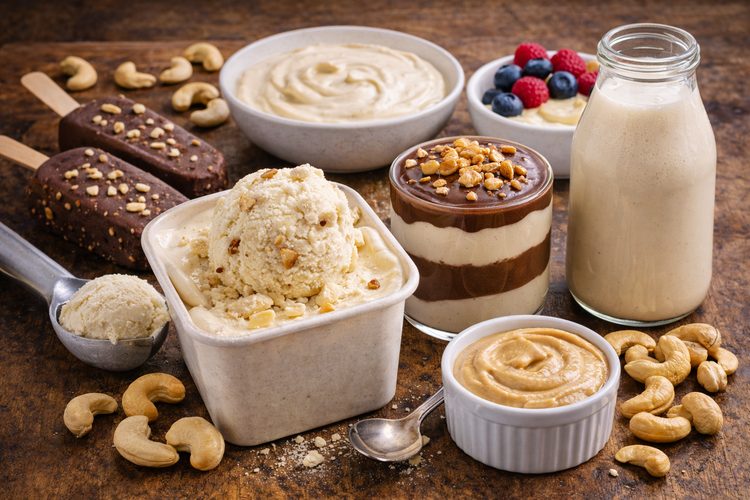
Cashews can move across multiple end uses, but cashews in frozen desserts and dairy alternatives are really about matching the format to the finished product, the process route and the target eating experience. Atlas positions cashew programs by asking what the ingredient needs to do in the system: build creaminess, support body, soften melt perception, carry flavor, support premium texture or create visible inclusions without disrupting processing efficiency.
In frozen desserts and dairy-alternative products, the commercial logic is rarely only about base ingredient price. The stronger outcome usually comes from aligning specification, process route, packaging and shipment timing before the order is placed. A buyer who asks only for “cashews for non-dairy frozen desserts” may receive answers that are technically related but commercially mismatched. A buyer who specifies format, target texture, pack style and destination usually gets a more useful quote and a more repeatable program.
Why cashews are so relevant in this category
Cashews are widely used in dairy alternatives and frozen desserts because they combine a relatively mild nut profile with a creamy sensory contribution. That combination is commercially useful. It allows formulators to build plant-based products that feel richer and more premium without forcing the flavor too aggressively in one direction. In many systems, the ingredient acts as both a functional and positioning tool at the same time.
For buyers, that matters because frozen desserts and dairy alternatives are highly experience-driven categories. A product can claim plant-based, dairy-free or premium status, but if the spoon feel, body, melt or finish disappoints, repeat purchase usually weakens. Cashew-based ingredients are often considered because they can help support a smoother, rounder eating profile in frozen formats and creamy alternatives. That is why sourcing decisions in this segment should be tied directly to texture goals and not only to category labels.
Buyer shortcut: a useful inquiry is not simply “quote cashews for dairy alternatives.” It is closer to “quote cashew butter for frozen dessert base,” “quote cashew flour for plant-based creamy formulation,” or “quote diced roasted cashews for premium frozen dessert inclusions.”
How this topic shows up in real buying decisions
In practice, buyers compare raw, pasteurized, dry roasted, oil roasted and processed formats such as diced cuts, meal, flour, butter and oil. For frozen desserts and dairy alternatives, the most commercially relevant forms are usually butter, paste, flour, meal and sometimes oil, because these formats integrate into creamy systems more naturally than visible whole-kernel ingredients. That said, diced and roasted inclusions may still be important in premium layered frozen desserts, toppings or specialty spoonable products.
For cashew buyers, the usable product menu often includes raw cashews, pasteurized cashews, dry roasted cashews, oil roasted cashews, diced cashews, meal, flour, butter and oil. Which of those makes sense depends on the end use, whether the customer is manufacturing further, packing for retail or planning export distribution. In frozen desserts and dairy alternatives, the commercial question usually becomes more focused: which cashew format best supports creaminess, body, stability, flavor and premium perception in the final product?
Most relevant cashew formats for creamy systems
Cashew butter and paste
Cashew butter and paste are often central in dairy-alternative and frozen-dessert programs because they can contribute body, richness and a more integrated nut profile. For many buyers, this is the most direct route when the cashew is expected to play a structural role in the base rather than appear only as a topping or visible inclusion. The right butter route depends on texture target, packaging format and how the ingredient will be handled on the line.
Cashew flour and meal
Cashew flour and meal may be used when the buyer wants a dry-format ingredient that will be built into a wider plant-based or dessert formula. These formats can be commercially useful when the process route, dry blending sequence or cost structure favors a flour-based approach rather than a butter-based one. The decision should still be tied to actual formulation behavior and finished-product goals.
Cashew oil
Cashew oil is a more specialized route, but it can matter in formulations where the buyer is considering richness, fat phase contribution or premium positioning through a cashew-derived oil stream. The logic depends on whether the oil is expected to contribute sensory identity, support a more neutral fat route or work within a broader formulation architecture.
Diced and roasted inclusions
Not every frozen dessert or dairy alternative uses cashews only in the base. Premium dessert lines may use diced, roasted or coated cashew inclusions for crunch, contrast or visual differentiation. In those cases, the sourcing logic starts to resemble confectionery or dessert inclusion buying as much as plant-based base formulation buying.
Where buyers commonly use cashews in frozen desserts
Plant-based frozen dessert bases
Cashew ingredients are often evaluated for plant-based frozen dessert bases because they can help support a smoother and richer profile. The buyer may be trying to create a more indulgent spoon feel, improve perceived creaminess or build a premium non-dairy platform that can carry multiple flavors. In this route, the ingredient must support both sensory experience and process practicality.
Premium pints and specialty cups
Retail frozen dessert lines often rely on texture and indulgence to justify pricing. Cashews may help support that premium logic through base richness, flavor depth or inclusion value. Here the buyer usually cares about finished product consistency, pack positioning and how well the ingredient supports a repeatable premium experience across flavor variants.
Frozen novelty and layered dessert concepts
In bars, sandwiches, layered cups or premium frozen novelties, cashews may appear in the base, in layers or as inclusions. The specification needs to reflect which role the ingredient is playing. A base ingredient and a topping inclusion are different buying tasks even when both come from the same raw nut family.
Where buyers commonly use cashews in dairy alternatives
Spoonable alternatives
Cashews are often commercially relevant in spoonable dairy-alternative systems because texture and creaminess are central to product acceptance. A buyer may use cashew formats to support body and richer mouthfeel while still maintaining a plant-based label route and premium ingredient story.
Drinkable and pourable systems
In drinkable applications, the decision becomes more sensitive to blendability, mouthfeel balance and formula direction. The cashew route should support the target consistency rather than create unnecessary heaviness or process friction. The sourcing decision therefore needs to reflect how the product is actually consumed.
Spreads, cultured alternatives and creamy culinary systems
Some cashew routes overlap with spoonable spreads, cultured alternatives and savory or sweet creamy applications. These may not always sit in the same aisle, but from a sourcing standpoint they often raise similar questions: what format delivers the target creaminess, what flavor intensity is wanted and what pack style supports production use?
What buyers usually compare technically
Creaminess and body contribution
One of the main reasons buyers turn to cashew ingredients is the expectation of creaminess. That does not mean every cashew format performs the same way. Buyers should therefore connect the chosen format to the desired body and eating experience of the final product rather than relying on ingredient family alone.
Flavor profile
Cashews are often valued because the flavor can be milder and more versatile than stronger nut profiles in certain applications. This makes them useful in vanilla, chocolate, fruit, coffee, caramel or dessert-led systems where the product should feel rich without becoming overly nut-dominant. The commercial value lies in flexibility.
Inclusion versus base role
Some frozen dessert buyers are buying cashews for the base. Others are buying them for visible crunch and premium garnish. Those are very different sourcing tasks. The first focuses on integration and system performance. The second focuses on appearance, bite and handling stability. Buyers should separate those routes clearly when requesting quotations.
Packaging and handling fit
Cashew butter, flour, paste, oil and diced inclusions all imply different receiving, storage and usage conditions. Packaging route is therefore part of the technical discussion, not a separate purchasing afterthought. A good product packed in the wrong route can still create production inefficiency.
What Atlas would ask before quoting
For cashew projects in frozen desserts and dairy alternatives, Atlas would generally recommend translating the product idea into a quote request with clear technical and commercial details. That makes it easier to discuss realistic California partner options instead of a broad price-only inquiry.
- What is the exact application: frozen dessert base, premium pint, novelty, dairy alternative, spoonable format, drinkable system, spread or another creamy application?
- What cashew format is being considered: butter, paste, flour, meal, oil, diced inclusion or another processed form?
- Is the ingredient intended for the base system, for visible inclusions or both?
- What is the primary objective: more creaminess, better body, richer flavor, premium positioning or inclusion contrast?
- Is the route industrial bulk, foodservice, retail-ready, private label or export-oriented?
- What pack style is required for storage, handling and line use?
- What is the volume rhythm: trial quantity, validation run, launch volume or repeat replenishment?
- What destination market and timing assumptions should shape the quote?
Typical use cases for cashews on this website include snacks, bakery, confectionery, plant-based dairy and spreads. In frozen desserts and dairy alternatives, the product brief should always connect the cashew format to the intended role in the system: creamy base, premium texture support, visible inclusion or broader plant-based positioning.
Commercial planning points
Commercially, these projects often develop in stages: trial quantity, validation run, launch volume and repeat replenishment. Atlas uses that logic to guide pack and shipment planning, especially when retail packaging, export retail or private label is part of the conversation. In creamy dessert and dairy-alternative categories, this staged logic matters because the formulation often needs confirmation before the ingredient route is locked into a broader commercial rollout.
When relevant, the brief should also mention whether the program is industrial bulk, foodservice, retail-ready, private label or export-oriented. That single clarification often changes packaging, documentation and timing assumptions. A production facility may prioritize bulk handling and stable repeat supply. A branded retail dessert line may place more emphasis on consistent sensory performance and premium positioning. An export route adds packaging and timing pressure on top of the ingredient decision itself.
Buyers should also compare offers on cost-in-use rather than nominal ingredient price alone. A cheaper route that underperforms in creaminess, base integration or premium perception may be less commercial than a slightly higher-cost ingredient that delivers a stronger finished product. In frozen desserts and dairy alternatives, the ingredient must justify itself through the consumer experience as much as through procurement math.
How Atlas thinks about specification-minded sourcing in this category
Atlas generally encourages buyers to move from broad category language to more functional sourcing language. In frozen desserts and dairy alternatives, that means defining whether the cashew ingredient is a structure-building component, a premium sensory tool, a plant-based positioning ingredient or an inclusion for contrast and visual value. That distinction usually drives the right choice on format, packaging and program size.
A frozen dessert base, a dairy-alternative spoonable product and a layered premium dessert may all use cashews, but they are not the same buying decision. The more clearly the buyer defines the product role, the easier it becomes to build a commercially useful quotation and a more repeatable sourcing route.
Buyer planning note
Atlas Global Trading Co. uses topics like this to move conversations from broad interest to a specification-minded inquiry. If you are evaluating cashews for frozen desserts and dairy alternatives, share the target application, required format, pack style, estimated volume and destination using the floating contact form so the next step can be grounded in a real commercial need. The practical objective is not only to buy cashews for a plant-based or frozen system. It is to source the right cashew route for the creaminess, texture, positioning and operational fit your finished product is intended to deliver.
Need help sourcing cashew ingredients for frozen desserts or dairy alternatives?
Use the contact form to turn this research topic into a practical quote request with format, pack style, process role and commercial timing.
- State the exact cashew format and application
- Add target monthly or trial volume
- Include destination market and target timing
Frequently Asked Questions
Why are cashews widely used in frozen desserts and dairy alternatives?
Cashews are widely used because they can support creamy mouthfeel, a mild nut-led flavor profile, premium positioning and flexible formulation across frozen desserts, spoonable dairy alternatives and drinkable plant-based systems.
Which cashew formats are most relevant in frozen dessert and dairy-alternative formulations?
Cashew butter, cashew paste, cashew flour, meal and in some cases oil are often the most relevant formats. Whole, diced or roasted formats may also appear in toppings, inclusions or premium layered dessert concepts.
What should buyers specify before requesting a quote?
Buyers should specify the intended application, target format, texture goal, packaging route, destination market, expected monthly or trial volume and whether the program is industrial bulk, foodservice, retail-ready, private label or export-oriented. Those details make quotations much more practical to compare.