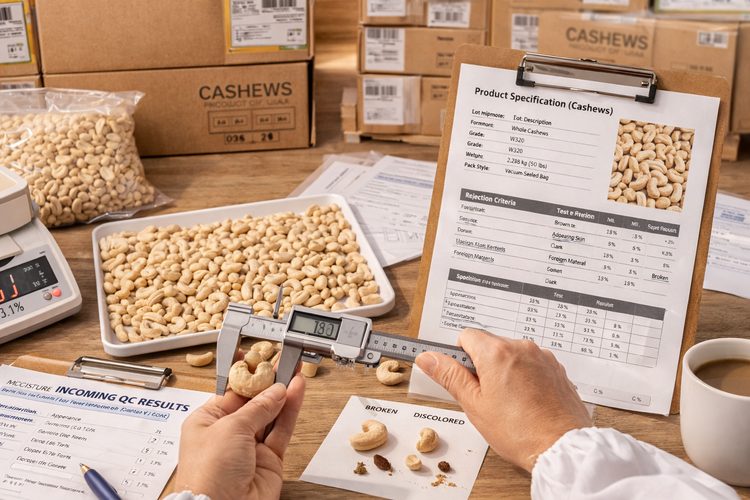
Incoming QC for cashew ingredients matters because industrial nut buying is rarely only about nominal price. The stronger commercial outcome usually comes from aligning specification, process route, packaging and shipment timing before the order is placed. Once the product arrives, the receiving step becomes the point where commercial assumptions are either confirmed or exposed. If incoming QC is weak, a buyer can approve the wrong lot, release material that does not fit the intended application or create unnecessary waste and line disruption even when the supplier relationship itself is sound.
For many buyers, incoming QC is not just a laboratory checkpoint. It is the first structured comparison between what was quoted, what was approved during sampling and what actually reached the warehouse or plant. That is why the best receiving programs combine document review, physical inspection, application-aware evaluation and release logic. The useful question is not only whether the product looks acceptable. It is whether the lot fits the approved commercial route with minimal downstream friction.
Why incoming QC matters commercially, not only technically
A receiving team can reject the wrong lots for the wrong reasons, but it can also approve unsuitable lots if the specification is too broad or the team is reviewing only generic quality points rather than application-relevant ones. In a cashew program, that creates hidden cost in the form of line stoppages, reduced yield, poor visual consistency, consumer complaints, repacking delays, shelf-life problems or reformulation work. A buyer who sees only invoice price will miss those losses.
This is why experienced purchasing and QA teams often treat incoming QC as part of supplier-management economics. A lot that passes on paper but slows bakery depositors, breaks too heavily in snack mixing, clumps in dry blending or shifts spread texture in a plant-based formula is not truly equivalent to a lot that performs correctly. Incoming QC therefore protects both product quality and commercial comparability across lots and across suppliers.
Buyer shortcut: incoming QC should confirm that the delivered cashew ingredient matches the intended job in the finished product, not only that it generally belongs to the correct nut category.
How this topic shows up in real buying decisions
For cashews, the quote should reflect the real format and route. Whole or kernel material is different from diced, meal, extra fine flour, butter or oil. The commercial logic also changes when the material is raw, pasteurized, dry roasted or oil roasted. A receiving program should therefore inspect the lot against the product’s real application rather than only against a broad product family description.
For cashew buyers, the usable product menu usually includes raw cashews, pasteurized cashews, dry roasted cashews, oil roasted cashews, diced cashews, meal, flour, butter and oil. Which of those makes sense depends on the end use, whether the customer is manufacturing further, packing for retail or planning export distribution. Incoming QC needs to reflect that. A retail whole-kernel snack line, a bakery inclusion program, a cashew butter route and a plant-based dairy application all require different receiving priorities.
What receiving teams usually review first
1) Product identity and lot match
The first question is basic but important: is the delivered product actually the approved product? Teams usually verify product name, format, lot code, pack count, net weight, date coding and any internal purchase-order references. This is the moment to catch wrong-item substitutions, format confusion or packaging mismatches before the product moves further into stock or production staging.
2) Packaging condition on arrival
Before sensory or analytical review, buyers often inspect the physical state of the shipment. Damaged cartons, compromised liners, loose seals, crushed packs, leakage in butter or oil formats, poor pallet stability or visible transit damage can all affect whether the product should be released, quarantined or escalated. Packaging is part of quality because it protects shelf life, appearance and handling integrity.
3) Required documents
Incoming QC often includes document review alongside physical inspection. That may involve the product specification, allergen statement, ingredient statement, lot-linked release data, shelf-life information or other commercial files required by the buyer’s internal approval process. If the documents do not match the delivered material, the receiving process is already incomplete even if the product looks visually acceptable.
Format-specific QC differences
Whole kernels and larger grades
For whole cashews, incoming QC usually pays close attention to size consistency, visual appearance, breakage level, color uniformity, cleanliness and physical integrity. If the product is intended for premium snack retail, decorative topping or visible inclusion use, the tolerance for appearance deviation may be tighter than in an industrial processing route. Whole-kernel programs often succeed or fail on presentation as much as on analytical compliance.
Diced and cut formats
Diced cashews are often evaluated for cut definition, size consistency, fines level, visible color balance and how well the lot matches the buyer’s process expectation. In bakery or snack systems, too many fines or too much size spread can affect distribution, visual consistency and cost-in-use. Incoming QC should therefore check not only that the product is “diced,” but that it is diced in the way the application expects.
Meal and flour formats
Cashew meal and flour usually require more attention to particle profile, flowability, visual uniformity, dryness and pack integrity. These formats are often used in technical formulation routes, so the receiving team may need to evaluate whether the product will disperse, blend or handle consistently in the intended system. Incoming QC in these cases is closely linked to process fit.
Cashew butter and paste
For butter and paste, the focus often shifts toward texture, consistency, oil behavior, fill condition, pack integrity and lot matching against approved sensory or handling expectations. A butter can be commercially unsuitable even if it is microbiologically acceptable, simply because it is too firm, too fluid, too separated or not aligned with the customer’s application method.
Cashew oil
Where oil is involved, incoming QC usually emphasizes identity, appearance, pack condition, documentation and confirmation that the stream matches what was quoted, whether the application expects a more distinctive or more neutral route. In these programs, release logic is often tied as much to formulation role as to basic receipt accuracy.
Application-driven QC checks
Snack and retail lines
Retail and snack programs often place more weight on appearance, bite, color, shelf-life readiness and pack presentation. Incoming QC needs to protect the premium visual and sensory promise of the finished line. Small visual or defect differences that may be acceptable in a further-processed route can become significant here.
Bakery and confectionery
Bakery and confectionery buyers usually care about how the ingredient behaves in mixing, depositing, baking or inclusion use. Incoming QC may therefore look more closely at size consistency, breakage, fines level, roast expression or moisture-linked handling behavior. The delivered ingredient must work in the process, not just in a sample bowl.
Plant-based dairy and creamy formulations
These routes often require receiving checks tied to texture, blendability, flow or fine-particle behavior. A raw or processed cashew ingredient can fit the specification on paper and still fail operationally if the delivered lot behaves differently in real formulation. Incoming QC should therefore be connected to how the ingredient will be used downstream.
Foodservice routes
Foodservice buyers may care more about pack usability, visual consistency, handling speed and practical kitchen fit. A large pack with poor reseal performance, a topping product with weak visual consistency or a butter that is difficult to handle after opening can all become service issues. Incoming QC should reflect the way the product is actually consumed.
Typical incoming QC checkpoints buyers may use
- PO and document match: correct item, pack size, lot, origin route and required paperwork.
- Packaging integrity: cartons, bags, liners, pails, drums, seals and pallet condition.
- Sensory review: appearance, aroma, color, visible defects and basic condition fit.
- Format verification: whole, pieces, diced, meal, flour, butter or oil match the approved route.
- Defect review: breakage, fines, discoloration, foreign-material risk indicators or lot inconsistency.
- Moisture and shelf-life fit: especially relevant for roasted, retail or export-oriented programs.
- Application awareness: whether the delivered lot will actually perform in the buyer’s intended use.
- Release decision: release, hold, quarantine, escalate or conditionally approve based on program rules.
How Atlas would ask buyers to think about receiving standards
Atlas encourages buyers to define intended use, pack style, destination, timeline and quality expectations early. For incoming QC planning, Atlas would also encourage buyers to define what a “good lot” means in their actual operating environment. That sounds simple, but it is often the missing step between a broad specification and a useful receiving process.
Typical questions before quoting or launching a repeat program may include:
- What exact cashew format is being purchased: whole, pieces, diced, meal, flour, butter or oil?
- Is the route raw, pasteurized, dry roasted or oil roasted?
- What is the intended application: snacks, bakery, confectionery, plant-based dairy, spreads or foodservice?
- Which incoming checks matter most for the buyer’s process: appearance, cut accuracy, breakage, flow, texture, pack condition or document match?
- Is the program industrial bulk, foodservice, retail-ready, private label or export-oriented?
- What minimum document set is required at receipt for release?
- Is the project at trial quantity, validation run, launch volume or repeat replenishment stage?
- How tightly does the buyer want lot-to-lot comparability managed for commercial continuity?
Typical use cases for cashews on this website include snacks, bakery, confectionery, plant-based dairy and spreads. The product brief should always match one of those concrete end uses, because incoming QC only becomes commercially useful when it reflects the real downstream application.
Commercial planning points
From a trading standpoint, the best programs are built around repeatability. That means clear documentation, agreed packaging, sensible shipment cadence and a commercial structure that supports continuity rather than one-off emergency buying. Incoming QC is part of that repeatability because it creates a disciplined bridge between approved specification and actual released inventory. Without that bridge, even good purchasing programs drift into lot-by-lot inconsistency.
Commercially, these projects often develop in stages: trial quantity, validation run, launch volume and repeat replenishment. Atlas uses that logic to guide supply discussions. Incoming QC should evolve in the same way. A trial lot may be reviewed more heavily for fit learning. A repeat program should ideally move toward a stable, efficient release model where the buyer knows exactly which checks are load-bearing and which ones are simply habitual.
When relevant, the brief should also mention whether the program is industrial bulk, foodservice, retail-ready, private label or export-oriented. That single clarification often changes packaging, documentation and timing assumptions. It may also change the acceptable risk tolerance at receiving and the speed at which a lot needs to be released into stock.
Why incoming QC improves supplier comparability
One of the strongest commercial benefits of structured incoming QC is that it gives the buyer a more honest basis for comparing suppliers and lots over time. Without a receiving framework, quality impressions often become anecdotal. With a receiving framework, teams can compare delivered lots against approved expectations in a more disciplined way. That does not mean overcomplicating the process. It means evaluating the features that actually affect cost-in-use and customer outcome.
This is especially useful when the buyer wants to reduce avoidable back-and-forth. A well-defined incoming QC program makes it easier to explain what was approved, what arrived and where the route did or did not match the agreed commercial need.
Buyer planning note
Atlas Global Trading Co. uses topics like this to move conversations from broad interest to a specification-minded inquiry. If you are evaluating cashew supply, share the exact format, intended application, pack style, estimated volume and receiving priorities using the floating contact form so the next step can be grounded in a real commercial need. In many successful cashew programs, incoming QC is not only a gatekeeping step. It is one of the main tools that keeps specification, lot performance and buying economics aligned over time.
Need help aligning receiving standards with a real cashew supply program?
Use the contact form to turn this topic into a practical quote request with product format, application, pack style and incoming-QC priorities.
- State the exact cashew format and end use
- Add target monthly or trial volume
- Include destination market and key QC priorities
Frequently Asked Questions
What should purchasing and QA teams review when cashew ingredients arrive?
Teams usually review the product identity, lot code, packaging condition, documents, sensory condition, format accuracy, defect profile, moisture expectations and whether the delivered lot matches the approved specification and intended application.
Why is incoming QC a commercial issue as well as a quality issue?
Incoming QC affects production release, inventory timing, yield consistency, customer complaint risk and supplier comparability. A weak receiving process can create hidden cost even when the invoice price looks competitive.
Does incoming QC differ by cashew format?
Yes. Whole kernels, diced cuts, meal, flour, butter and oil all raise different practical checks. Visual appearance, piece size, flowability, oil behavior, moisture sensitivity and packaging fit vary by product route.