Hero pack or assortment component?
Buyers need to decide whether the cashew is the primary product or one premium element within a broader gift or mixed nut concept.
Buyer guidance on premium positioning, seasonal gifting, pack architecture, product selection and commercial planning for cashew retail and private label programs.
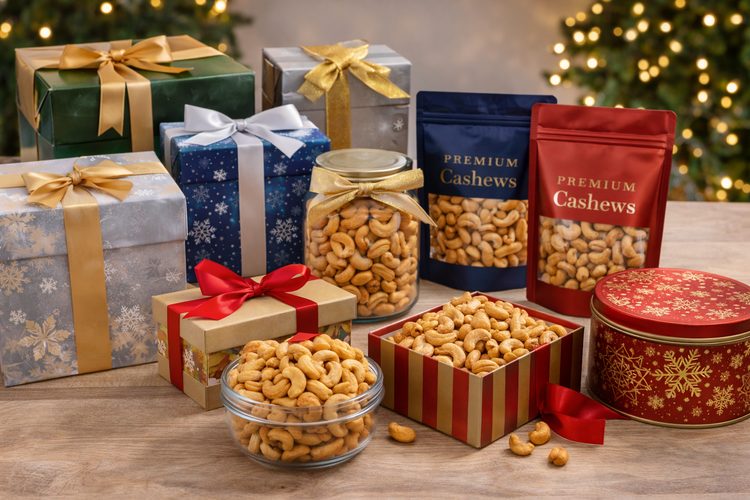
Seasonal and premium cashew pack concepts matter because retail gifting, promotional launches and upscale snack positioning are not driven by ingredient cost alone. They are driven by presentation, eating quality, perceived value, gifting suitability and the ability to reach the market in the right format at the right moment. In these programs, the product is not only a nut. It is a packaged commercial experience, and cashews often play a central role because they combine premium visual appeal with a mild buttery flavor profile that works across plain, roasted and flavored concepts.
For Atlas Global Trading Co., this topic sits at the intersection of product selection, packaging logic and commercial timing. A premium cashew pack program often includes more than choosing whole roasted kernels and placing them into an attractive pouch or tin. It requires decisions about size and style, roast level, flavor direction, packaging barrier, seasonal graphics, label structure, case count, replenishment timing and destination market fit. A program that looks strong in concept can lose margin or execution quality if those elements are not aligned early.
This is especially relevant in California-linked sourcing and packing discussions because buyers often use these projects to serve multiple channels at once. A single product family may appear as a holiday retail item, a corporate gifting format, a club-ready seasonal assortment, an export-oriented premium snack pack or a private label promotional line. The same cashew can therefore move through very different packaging and commercial pathways depending on the final customer.
In practice, seasonal and premium cashew pack decisions usually begin with one core commercial question: what role is the cashew supposed to play in the finished offer? In some programs, cashews are the hero ingredient and the pack is built around whole kernels, roast quality and a luxury presentation. In others, they are one element in a premium mixed nut or gifting assortment, where pack harmony, assortment balance and visual merchandising matter as much as the cashew itself.
Buyers also have to decide whether the product is intended for impulse premium snacking, festive gifting, hospitality placement, corporate seasonal gifting, travel retail, export retail or a broader upscale private label line. Each use case changes how the cashew should be presented. A gifting tin may prioritize appearance, portion abundance and premium graphics. A slim stand-up pouch for modern retail may prioritize shelf efficiency and repeat purchase. A rigid box concept may emphasize gifting value and display impact. A club or export pack may place greater focus on count, durability and transport efficiency.
The commercial logic also changes when the buyer is comparing plain roasted cashews, oil roasted styles, seasoned cashews, honey-style concepts, savory gourmet profiles or indulgent sweet-and-savory flavor directions. Seasonal programs often invite more adventurous flavor development, but every added layer of complexity affects shelf stability, packaging choice, ingredient deck, artwork claims and lead-time planning.
Cashews are commonly selected for premium packs because they support multiple value signals at once. They look premium, they eat gently compared with harder nuts, and they accept both simple and complex flavor systems. Whole cashews create immediate visual recognition and are often associated with upscale snacking. Their smooth curved shape, lighter surface color and relatively uniform appearance make them especially suitable for retail-ready presentation.
From a sensory standpoint, cashews offer a mild, rich base that works in lightly salted, dry roasted and flavored programs without overpowering the overall concept. This makes them commercially flexible. A buyer can position them in minimalist premium packs that emphasize quality and simplicity, or in more elaborate seasonal packs with bold seasoning concepts and mixed assortments.
Cashews also adapt well to premium price architecture. They can serve as the primary value anchor in a single-item pack, or as one of the high-perceived-value ingredients in a seasonal assortment. That flexibility matters when building product ladders such as standard premium, festive premium and gifting premium tiers within the same brand family.
In seasonal and premium cashew programs, format selection strongly affects both appearance and commercial positioning. Whole kernels are the most common choice because they support a more upscale visual identity. Larger, cleaner and more uniform whole styles are often favored when the buyer wants the pack to communicate generosity, polish and premium ingredient quality. These styles are particularly relevant in tins, jars, windows, tray-packed assortments and transparent or semi-transparent pouch concepts.
Splits or pieces may still be relevant in some premium applications, especially where flavor coating, cluster systems or blend concepts matter more than individual kernel presentation. However, when the cashew is the hero product, broken material usually weakens perceived value unless the concept is intentionally built around a seasoned bite-size snack format.
Buyers should also define whether the line will use raw, pasteurized, dry roasted or oil roasted cashews. For most premium retail and gifting packs, roasted styles are the practical default because they deliver immediate flavor readiness and a more snack-forward eating experience. Dry roasted cashews can support cleaner flavor presentation and a crisp premium profile. Oil roasted options may support deeper flavor, richer seasoning carry and stronger indulgence cues, but can also affect packaging needs and shelf-life behavior.
Premium and seasonal pack concepts often expand beyond plain salted profiles. Buyers may develop limited-time offerings around savory spice blends, sweet-and-salty combinations, herb-driven profiles, festive seasoning concepts or regionally inspired flavor stories. The challenge is to balance novelty with commercial practicality. A flavor that sounds strong in marketing language still needs to perform on line, hold on shelf and fit the brand’s price and packaging model.
In many successful seasonal cashew programs, the flavor system does not overwhelm the nut. Instead, it amplifies the premium character of the cashew. Light seasoning concepts may preserve the visible identity of whole kernels and allow the ingredient to remain the focus. Heavier coatings can create stronger differentiation but may shift the pack closer to a novelty profile that has a narrower sales window.
Flavor choice also affects technical handling. Seasoning adhesion, oil management, breakage during tumbling, dust generation and visual consistency all matter. Programs using flavored whole cashews should consider whether the line needs a glossy finish, a matte dry seasoning look or a more natural appearance. These decisions influence processing route, packaging cleanliness and the final consumer impression when the pack is opened.
Packaging is one of the biggest commercial differentiators in seasonal and premium cashew concepts. The same cashew can feel mainstream, premium or giftable depending on the structure it is packed in. Flexible pouches often work well for modern premium retail because they balance cost, barrier protection, shelf presence and logistics efficiency. Rigid jars can signal premium pantry value and reusability. Tins and paperboard gift boxes are especially relevant in seasonal gifting because they elevate presentation and can support corporate or festive positioning.
The choice should reflect the actual route to market. A seasonal supermarket feature may need a pouch or carton that merchandises efficiently and protects margin. A corporate gifting project may justify a more expensive rigid or decorative structure because presentation is part of the product value. A private label export project may need a format that balances premium appearance with container density and transit durability.
Window features, matte finishes, metallic accents, embossing language, ribbon-style design cues and limited-edition graphics can all strengthen perception, but they also increase packaging coordination and planning complexity. Buyers should therefore decide whether the value is being created primarily through the nut quality, through the packaging, or through the combined premium presentation of both.
Seasonal cashew programs are often less forgiving than standard year-round lines because timing is part of the value proposition. Missing the intended window can reduce the commercial impact of the pack or force discounting. For that reason, these projects should be planned backward from the actual in-market date rather than from the nominal production date.
Artwork approval, packaging material lead times, ingredient procurement, roasting and packing capacity, promotional planning and freight timing all matter. In seasonal projects, the pack itself may be date-sensitive or event-sensitive, which reduces flexibility if delays occur. Export-oriented seasonal programs add more complexity because ocean transit, customs clearance and destination warehousing can materially change the launch calendar.
Commercially, this means buyers should identify whether the program is a one-season trial, a repeating annual SKU, a holiday-exclusive promotion or part of a broader premium portfolio with seasonal extensions. Each structure affects how Atlas and its partners would think about MOQ, pack supply commitment, replenishment risk and launch sequencing.
Typical use cases for cashews on this website include snacks, bakery, confectionery, plant-based dairy and spreads. In seasonal and premium pack programs, the product brief should define whether the cashew is a hero retail snack, a gifting line, a mixed assortment component, a private label concept or an export-ready premium pack.
For premium and seasonal cashew projects, Atlas would typically ask buyers to define five core inputs early: target cashew format, intended application or retail concept, pack style, destination market and volume rhythm. On these projects, however, a stronger brief usually includes more detail than a standard commodity-style inquiry. The supplier also needs to understand presentation objectives, price tier, whether the product is plain or flavored, whether gifting is a core function, and whether the line is meant for domestic retail, export, private label or corporate distribution.
Atlas would also ask how the buyer intends to differentiate the finished offer. Is the value in larger whole kernels, a distinctive flavor profile, a more premium container, seasonal graphics, or a bundled assortment? Understanding that priority helps determine where cost should be concentrated. Some programs are strongest when the ingredient quality is emphasized through a simpler premium pack. Others require a more elaborate gift structure because the physical presentation is part of the commercial promise.
Another major quoting point is pack-out configuration. Buyers should specify target unit weight, case count, outer shipper expectations, retail display needs, barcode and labeling requirements, destination language or compliance needs, and whether the product must fit existing shelf sets or gifting cartons. These inputs reduce avoidable back-and-forth and make quote comparisons more meaningful across program options.
Seasonal and premium cashew programs are often built in stages. A buyer may begin with a concept review and early target cost discussion, then move to sample evaluation, trial packaging, validation run, launch production and repeat seasonal replenishment. Atlas uses that logic to help structure conversations so the program is not treated like a simple spot buy. Premium packs usually require more alignment than standard bulk or basic retail programs.
Commercially, these projects often succeed when buyers think in tiers. A brand may use one premium core cashew line year-round, then build seasonal extensions with different graphics, flavors or gift pack formats. This reduces development risk because the program builds on an existing platform. Other buyers choose the opposite route and create one-time event packs where the packaging carries much of the differentiation. Both strategies can work, but the sourcing and packaging logic should match the brand’s actual sales rhythm.
Price architecture is another key factor. Because cashews already sit in a relatively premium ingredient position, buyers should be clear about whether the program is intended to be accessible premium, gifting premium or luxury premium. That decision affects everything from kernel style and seasoning complexity to packaging materials and case structure. A product with a luxury visual concept but a mid-tier ingredient execution can feel mismatched. Likewise, a very high-quality cashew packed in an underdeveloped structure may not communicate full value to the customer.
When relevant, the brief should also mention whether the program is retail-ready, private label, corporate gifting, club-oriented, export retail or promotional. That single clarification often changes packaging, documentation, case build and timing assumptions.
Premium appearance has to survive the full supply chain. That means seasonal and premium cashew packs should be built with both presentation and product protection in mind. High-barrier packaging, proper sealing and careful pack handling help preserve flavor and reduce oxidation risk, especially in roasted and flavored cashew lines. This becomes even more important when the selling window is short and the buyer cannot rely on long replenishment cycles to correct quality or appearance issues in market.
Rigid and decorative structures may improve visual value, but the internal barrier system still matters. A decorative outer carton cannot compensate for poor internal product protection. Buyers should therefore evaluate packaging as a layered system: inner barrier, finished retail appearance, case configuration and transit durability. Premium gifting programs are especially exposed because customers often evaluate them visually before opening them.
If the program is intended for longer transit, export placement or premium e-commerce fulfillment, packaging should also reflect the realities of shipment stress, temperature variation and handling. A pack that works in a local retail environment may need further refinement for export or parcel-based gifting models.
Many premium cashew concepts are developed for private label or export customers rather than a single domestic brand. In those cases, the core product may stay similar while the label language, net weight norms, shipper marks, regulatory statements and case configuration vary by destination. This makes early structure even more important. Buyers that plan private label and export projects together can often reuse flavor and product logic while customizing packaging and documentation to the final market.
Export programs may also need more conservative planning around launch windows, container utilization and shelf-life buffer. For seasonal packs, the consequences of delay can be commercially significant. That is why Atlas encourages customers to define not only the destination market, but also the retail calendar, launch expectation and any fixed promotional timing the line must meet.
In real buyer conversations, the most common trade-offs are usually straightforward but important. Should the pack invest in larger whole cashews or more decorative packaging? Should the line stay plain roasted to emphasize nut quality, or adopt a premium flavor to create distinction? Should the product be built for broad upscale retail, where cost and shelf efficiency still matter, or for a more limited gifting environment where presentation can carry a larger part of the margin? None of these are purely creative questions. They are packaging, sourcing and commercialization questions at the same time.
That is why Atlas positions premium cashew pack discussions around what the product must accomplish in market. The pack may need to signal generosity, seasonal exclusivity, modern premium quality, corporate gifting polish or export-ready sophistication. Once that commercial objective is clear, the product form, packaging route and supply structure become easier to define.
Atlas Global Trading Co. uses topics like this to move conversations from broad interest to a specification-minded inquiry. If you are evaluating seasonal or premium cashew packs, share the target format, roast or flavor direction, pack style, estimated volume and destination market so the next step can be grounded in a real commercial need.
For many buyers, the strongest outcome comes from treating the program as a coordinated product system rather than a standalone ingredient purchase. Cashew selection, pack architecture, price tier, launch timing and market channel should all be aligned from the start. Atlas works from that logic to help customers move from concept language to practical sourcing, packing and shipment decisions.
Seasonal and premium cashew packs are usually evaluated on a mix of appearance, cost position, channel fit and launch timing rather than ingredient specification alone.
Buyers need to decide whether the cashew is the primary product or one premium element within a broader gift or mixed nut concept.
Plain roasted lines emphasize nut quality, while flavored lines can create stronger seasonal or differentiated positioning.
Each structure changes cost, perceived value, shelf presence, transit durability and merchandising flexibility.
Seasonal projects often need timing planned around exact launch windows, not just general shipment readiness.
Brand ownership affects artwork timing, packaging inventory, labeling structure and commercial approval flow.
The intended price tier helps determine how much value should sit in the kernel quality, flavor complexity and packaging structure.
Use the contact form to turn this premium or seasonal pack concept into a practical quote request for Atlas and its California processing and packaging partners.
The main takeaway is that premium cashew pack programs work best when format, seasoning style, packaging presentation, shelf-life needs and commercial timing are planned together.
Whole kernels, large whole styles, dry roasted cashews, oil roasted cashews and flavored cashews are the most common premium retail formats because they support strong visual appeal and giftable product presentation.
Packaging matters because seasonal and gifting programs rely on visual impact, perceived value, transit protection, shelf stability and presentation consistency at the exact moment the item reaches the customer or retail shelf.
Yes. Premium cashew programs can be adapted for domestic retail, corporate gifting, export retail and private label, but labeling, pack structure, case configuration, documentation and shipment timing may vary by market.